Introduction
Fintech founders and hiring managers face a unique challenge: they're scaling fast, but the roles that matter most—compliance, financial crime, risk, legal—require candidates with specific domain knowledge that generalist job boards and broad-market firms can't reliably deliver. A bad hire in a regulated role isn't just a people problem; it can mean regulatory fines, failed audits, or stunted growth.
In October 2024, FinCEN assessed a record $1.3 billion penalty against TD Bank for BSA violations. That same year, the CFPB fined Chime Financial $3.25 million and GreenSky $2.5 million for compliance failures. The pattern is consistent across the industry: compliance infrastructure gaps—including staffing gaps—translate directly into regulatory exposure and financial penalties.
This guide explains what a staffing firm is, how the process works, which services fintech companies rely on most, and what separates specialist firms from generalists when regulated hiring is on the line.
TLDR
- A staffing firm connects businesses with qualified candidates for temporary, contract, or permanent roles, handling recruitment end to end
- Specialist firms focused on fintech have deep domain knowledge and pre-built networks of compliance, risk, legal, and financial crime professionals
- For fintech companies (Seed to Series C), choosing a specialist firm reduces time-to-hire and the risk of regulatory mismatch
- The best staffing partners bring market intelligence, counter-offer prep, and post-placement support
- At 63 days average time-to-hire, financial services is the slowest-hiring industry — making specialist networks critical
What Is a Staffing Firm?
A staffing firm acts as an intermediary between employers and qualified job candidates, handling sourcing, screening, and placement for temporary, contract, or permanent roles. Unlike a job board, a staffing firm takes an active role in identifying and vetting talent on your behalf — often including payroll and compliance administration for placed workers.
How Staffing Firms Differ From Other Hiring Models
Not all hiring partners work the same way:
- Recruiting agencies focus on permanent, typically senior placements — executive search territory
- Temp agencies handle short-term fill-ins, usually for high-volume or hourly roles
- Staffing firms cover the full spectrum, and often manage employment administration (payroll, compliance) for workers they place
Within staffing, specialization separates firms that know your market from those that don't. A fintech-focused firm brings deeper candidate networks and domain knowledge than a generalist firm splitting attention across healthcare, retail, and financial services simultaneously.
For compliance, AML, or BSA roles specifically, this gap shows up fast. A recruiter who can't distinguish a BSA Officer from a Compliance Analyst — or who's unfamiliar with FinCEN obligations and state licensing requirements — will consistently surface the wrong candidates.
How Does a Staffing Firm Work?
Needs Assessment and Consultation
The process begins with a detailed intake: the staffing firm learns about the role requirements, the company's growth stage, team culture, compensation range, and regulatory environment. For fintech, this step should also surface whether the hire needs domain-specific credentials—such as CAMS certification, BSA experience, or state licensing knowledge.
The FFIEC BSA/AML Manual requires boards to designate a qualified BSA compliance officer under federal regulations. This isn't a discretionary hire—it's a regulatory mandate. The officer must have appropriate authority, independence, access to resources, and competence. A specialist staffing firm understands this; a generalist often doesn't.
Candidate Sourcing: Network-First vs. Database-First
Two fundamentally different approaches exist: database-first firms run keyword searches through large applicant pools, while network-first firms go directly to people they know personally before posting anything.
Why the network-first approach matters in fintech: the most qualified compliance and risk professionals are often passive candidates who aren't actively applying anywhere. Lou Adler's research with LinkedIn found that 65-75% of professionals are passive, and networking outperforms direct applications by a ratio of 7:1 for this group.
The Gem 2025 Recruiting Benchmarks Report analyzed 1.3 million hires and found that direct sourcing (outbound recruiting) generates 9.94% of all hires despite representing only 2.47% of applications—a 4x efficiency multiplier. Referrals deliver a 10.4x multiplier. Job boards, meanwhile, account for 49% of applications but only 24.55% of hires—a 0.5x efficiency rate.
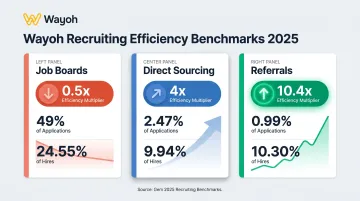
For niche fintech roles, sourcing philosophy is the single biggest differentiator in outcome quality.
Screening, Vetting, and Shortlisting
The screening process includes:
- Initial interviews to assess technical competency and regulatory knowledge
- Skills and experience verification
- Background and reference checks
- Cultural fit assessment
For regulated roles in fintech, vetting should also validate:
- Whether they understand FinCEN reporting obligations, SAR filing thresholds, or CTR requirements
- Whether they've built or managed AML programs, conducted independent audits, or navigated regulatory examinations
- Whether they hold CAMS, CRCM, or other relevant credentials
The BLS projects 33,300 annual openings for compliance officers through 2034, with 418,000 existing jobs and only 3% growth. Finance and insurance employs 12% of all compliance officers. The talent pool is finite and credentialed—vetting must be rigorous.
Placement, Offer Support, and Onboarding
Rigorous vetting only matters if the candidate crosses the finish line. A strong staffing firm stays engaged through the offer stage and beyond, covering:
- Compensation benchmarking guidance
- Counter-offer preparation
- Managing the transition period
- Checking in during onboarding to ensure a successful start
Wayoh goes to personal networks before posting anything and stays with clients from the founding hire through full-team build-out, drawing on 10+ years in banking and fintech and 500+ professionals placed.
Types of Staffing Services Fintech Companies Use
Direct Hire (Permanent Placement)
Direct hire is the most common model for fintech's critical roles: the staffing firm recruits and places a full-time employee who joins the client company directly on their payroll. This is the standard approach for compliance officers, BSA/AML specialists, risk managers, legal counsel, and senior commercial hires where continuity and cultural integration matter most.
According to the American Staffing Association, direct placement involves finding qualified job candidates and bringing them together with potential employers for the purpose of establishing a permanent employment relationship. Contingency fees are paid upon hire.
Contract Staffing
Contract staffing places professionals for a defined scope or timeframe — useful for fintech companies navigating a regulatory audit, building out a compliance program, or needing interim leadership during a transition. The worker is typically employed by the staffing firm, which handles payroll and compliance. Not every search firm offers this model; some, like Wayoh, focus exclusively on direct hire and executive search.
Temp-to-Perm
Temp-to-perm arrangements allow fintech companies — especially early-stage ones — to evaluate a candidate's performance and cultural fit before committing to a full-time offer. This reduces the risk of a costly mis-hire while still accessing talent quickly. As with contract staffing, availability varies by firm.
Executive and Specialized Search
Executive search is used for senior and specialized roles: Chief Compliance Officer, Head of Financial Crime, VP of Risk, or General Counsel. This type of search requires a firm with real relationships at the leadership level, not just an ATS full of resumes.
According to the ASA, retained search is typically reserved for management and executive positions, with the firm charging a retainer upfront. Unlike contingency search, the client pays fees regardless of whether a hire results — reflecting the deeper, more exclusive nature of the process.
Choosing the Right Service Type for Your Stage
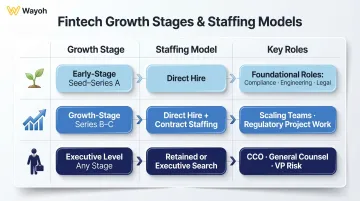
Different hiring needs call for different models. Here's how fintech companies typically approach this by growth stage:
| Company Stage | Recommended Model | Best For |
|---|---|---|
| Early-stage (Seed–Series A) | Direct hire | Foundational roles: compliance, engineering, legal |
| Growth-stage (Series B–C) | Direct hire + contract staffing | Scaling teams, regulatory project work |
| Executive level (any stage) | Retained or executive search | CCO, General Counsel, VP Risk |
Gartner and Harvard Business Review research finds that a failed executive hire can cost 10 to 15 times the executive's annual salary. For a CCO earning $200,000–$400,000, that can translate to millions once you factor in severance, regulatory exposure, lost productivity, and team disruption.
Getting the model right from the start is how fintech companies avoid that cost entirely.
Why Fintech Companies Need a Specialist Staffing Firm
Regulatory Complexity Requires Domain-Fluent Recruiters
Fintech roles in compliance, AML, BSA, financial crime, and risk are not interchangeable with general finance or operations roles. A recruiter who doesn't understand the difference between a BSA Officer and a Compliance Analyst—or who can't speak to state licensing requirements, FinCEN obligations, or Bank Secrecy Act nuances—will consistently send unqualified candidates.
Specialist staffing firms recruit within these domains daily and screen accordingly. They know what CAMS certification means, why BSA experience at a regulated institution differs from generic compliance work, and how to evaluate sanctions screening expertise.
The Best Candidates Aren't on Job Boards
Top-performing compliance and risk professionals in fintech are almost never actively job searching. They're in networks built over years of working together, attending industry events, and building reputations.
Lou Adler's research indicates that 85% of critical jobs are filled via networking, with passive candidates representing 65-75% of the talent market. A staffing firm with genuine relationships in the market can reach these passive candidates; a generalist firm with a database cannot.
Speed Matters at Every Growth Stage
Fintech companies face urgency when hiring: a missing compliance hire can delay a product launch, a regulatory response, or a Series B close.
The Gem 2025 Recruiting Benchmarks Report shows that financial services takes 63 days to hire on average—the longest of any industry tracked, and 12 days longer than in 2021. Legal/Compliance roles require 47 days and 29 interviews per hire. The application-to-hire rate has fallen to 0.4%, down from 1.6% in 2021—meaning hiring teams must process significantly more candidates for each successful placement.
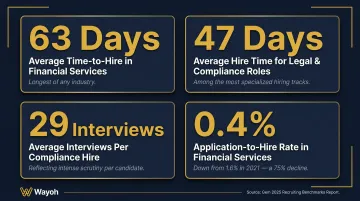
A specialist firm with a pre-built network can reduce time-to-fill significantly versus starting a search from scratch.
Cultural Fit in Fast-Growth Environments Is Hard to Assess
Fintech's pace, ambiguity, and structure are distinct from traditional banking or enterprise tech. A staffing firm that works exclusively in this space understands what "early-stage fintech culture" means and can evaluate candidates not just on credentials but on whether they'll thrive in that environment.
Seed-stage fintech requires candidates who operate comfortably in ambiguity, move from strategy to execution without friction, and own outcomes without needing structure. A generalist recruiter can't assess these traits; a specialist can.
### What a Consultative Staffing Partner Actually Does Differently
A transactional firm sends resumes and collects a fee. A consultative partner brings market intelligence, advises on compensation benchmarking, prepares both sides for counter-offers, and stays engaged through onboarding. The gap in outcomes between those two models is significant.
Wayoh operates in the second category. With 10+ years in banking and fintech and 500+ professionals placed, every search starts with personal networks before anything gets posted — and support continues from the founding hire through full-team build-out.
How to Choose the Right Staffing Firm for Your Fintech
Ask Questions Only a Real Specialist Can Answer
Look beyond marketing claims: ask the firm to name the specific compliance, AML, or fintech roles they've placed in the last 12 months. A firm that specializes in fintech should speak fluently about:
- Regulatory frameworks (FinCEN, Bank Secrecy Act, state money transmission licensing)
- Typical compensation bands for key roles
- The difference between hiring for a crypto company versus a payments platform
If they struggle with any of these, keep looking — a generalist recruiter will cost you time and credibility with candidates who expect the firm reaching out to understand their world.
Find Out Where Their Candidates Actually Come From
Ask directly: "Do you go to your personal network first, or do you post the role and search a database?"
Network-first firms—like Wayoh—access candidates who won't appear on a job board. Database-first firms recycle the same active candidates that every other firm is also approaching. For niche fintech roles, sourcing philosophy is often what separates a strong shortlist from a forgettable one.
Distinguish a Partner from a Vendor Before You Sign
A genuine staffing partner looks like this in practice:
- Clear, consistent communication
- Transparent fee structures with no hidden costs
- Proactive market intelligence (what compensation the market is paying, what counter-offers look like)
- Active support through offer negotiation and the first 90 days of onboarding
Firms that go quiet after sending a shortlist are vendors; firms that stay engaged are partners.
The right firm won't just fill your open role — they'll tell you things about the market you didn't know to ask.
Frequently Asked Questions
What is a staffing firm?
A staffing firm connects businesses with qualified candidates for temporary, contract, or permanent roles, handling sourcing, screening, and often administrative tasks like payroll on the employer's behalf.
What do staffing firms do?
Staffing firms manage the full recruitment process—from identifying and vetting candidates to facilitating placement and supporting post-hire onboarding—so employers can focus on running their business.
What does it mean to work through a staffing firm?
Working through a staffing firm means outsourcing part or all of the hiring process to a specialist partner. The firm handles sourcing, screening, and often offer management—so your team engages only with candidates already vetted for the role.
What is the 70/30 rule in hiring?
The principle that roughly 70% of jobs are filled through networks and relationships rather than public postings. Lou Adler's research puts that figure even higher—85% for critical roles—which is why firms with genuine personal networks tend to surface stronger candidates than those relying on job boards alone.
How is a staffing firm different from a recruiting agency?
Recruiting agencies typically focus on permanent placements (often senior roles), while staffing firms cover the full spectrum—contract, temporary, and direct hire—and frequently handle employment administration for placed workers too.
How do staffing firms charge for their services?
Staffing firms typically charge a placement fee based on a percentage of the hired candidate's first-year salary for permanent placements, or a markup on hourly rates for contract and temporary staffing. Fee structures are typically disclosed before any search begins.