Introduction
HealthTech companies face a compliance paradox: they're subject to the same HIPAA, OIG, CMS, and state licensing requirements as established hospitals, yet they're building compliance functions from scratch while scaling at startup speed.
Many struggle with credential verification systems, multi-state telehealth licensing, and worker classification rules — gaps that don't show up until an audit or a contract negotiation puts them under the microscope. U.S. digital health startups raised $14.2B in 2025, a 35% increase over 2024, and that hiring pressure makes compliance missteps far more costly.
Here's what this guide covers:
- The specific compliance challenges HealthTech organizations face when staffing
- The financial and operational consequences of getting it wrong
- Practical strategies to build a compliant hiring infrastructure while scaling
TLDR
- HealthTech faces more complex compliance than traditional providers due to multi-state operations, rapid scaling, and digital delivery models
- The five pressure points: multi-state telehealth licensing, OIG exclusion monitoring, HIPAA-compliant hiring, credential verification, and worker classification
- Penalties run up to $23,000+ per service — plus reimbursement clawbacks, lost contracts, and damaged patient trust
- Defense requires documentation standards, continuous monitoring, compliance-aware hiring, and regular internal audits
Why Healthcare Staffing Compliance Is Different for HealthTech Organizations
HealthTech operates at the intersection of healthcare regulation and technology scale. Companies face the same HIPAA, OIG, CMS, and state licensing requirements as traditional providers—but without the institutional compliance infrastructure that hospitals have built over decades. The OIG General Compliance Program Guidance (2023) explicitly includes digital health and SaaS companies—so the obligations apply whether a company has 10 employees or 10,000.
The Speed Problem
With average digital health deal sizes climbing from $20.7M to $29.3M, companies face pressure to scale headcount rapidly after funding rounds. Hiring at startup speed without compliance rigor creates credential gaps and monitoring blind spots that surface during audits. Fifteen new digital health unicorns emerged in 2025, up from six in 2024—growth trajectories that demand immediate talent acquisition while compliance systems are still maturing.
Dual Hiring Complexity
HealthTech companies must staff two fundamentally different role types at the same time, each with its own compliance demands:
- Clinical roles: Require active licensure verification, credentialing, and ongoing OIG exclusion checks
- Commercial and operational roles: Require working knowledge of HIPAA, CMS billing guidelines, and state telehealth laws
Most compliance guidance is written for one category or the other—not both running in parallel.
Digital Delivery Introduces Jurisdictional Complexity
Telehealth platforms, remote monitoring services, and app-based care create compliance challenges that brick-and-mortar clinics never face. Practitioners may serve patients across multiple states simultaneously, triggering multi-state licensing requirements. A telehealth platform serving 30 states must track licensure compacts, state-specific credentialing rules, and specialty-by-specialty variations all at once—a scope no single-location clinic ever encounters.
The Key Healthcare Staffing Compliance Challenges HealthTech Companies Face
Navigating Multi-State Telehealth Licensing Requirements
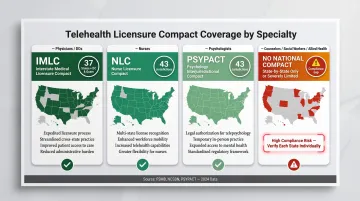
Telehealth platforms must ensure every licensed clinical professional holds valid licensure in each state where patients are served—not just where the provider is based. The Interstate Medical Licensure Compact (IMLC) covers only MD/DO physicians across 37 states plus DC and Guam. The Nurse Licensure Compact (NLC) covers 43 nursing jurisdictions, and PSYPACT covers 43 psychology jurisdictions.
Critical gaps remain:
- Counselors, social workers, and many allied health professionals require state-by-state licensure
- The Counseling Compact has passed in approximately 39 jurisdictions but only Arizona, Louisiana, Minnesota, and Ohio have completed full implementation
- Physical therapists, speech-language pathologists, and dietitians face limited compact adoption
HealthTech companies employing multi-disciplinary clinical teams face layered licensing complexity for non-physician providers. The IMLC and NLC ease some burden, but active tracking of each provider's licensure status across applicable states is required. Self-reporting is not enough.
OIG Exclusion Monitoring and Ongoing Background Checks
The Office of Inspector General maintains a List of Excluded Individuals and Entities (LEIE). If a HealthTech company that bills Medicare, Medicaid, or contracts with covered entities employs an excluded individual—even unknowingly—it faces civil monetary penalties under 42 U.S.C. 1320a-7a.
Penalty structure:
- Up to $23,000+ per item or service (inflation-adjusted from $10,000 statutory base)
- Treble damages (up to 3x the amount claimed)
- Program exclusion for the entity
These penalties accumulate fast—and most violations stem from a gap in monitoring, not initial screening. Many companies conduct one-time background checks at onboarding without ongoing monitoring. New criminal activity, disciplinary actions, or exclusions that arise post-hire go undetected. The OIG Special Advisory Bulletin (2013) recommends monthly LEIE checks, not just at hire.
Compliance liability does not transfer to a staffing vendor or app. The hiring HealthTech organization remains responsible for ensuring staff remain eligible throughout their engagement.
HIPAA Compliance in the Hiring Process
HIPAA's requirements extend into the hiring process itself. Background check platforms, credential verification systems, and applicant communications must all use secure, HIPAA-compliant channels to protect candidate and patient information.
Penalty tiers (2026 inflation-adjusted):
- Tier 1 (lack of knowledge): $145 to $36,505.50 per violation
- Tier 2 (reasonable cause): $1,461 to $73,011
- Tier 3 (willful neglect, corrected): $14,602 to $73,011
- Tier 4 (willful neglect, not corrected): $73,011 to $2,190,294 per violation
OCR has resolved 152 enforcement cases totaling $144.9M to date. HR staff at HealthTech companies often lack formal HIPAA training, creating unintentional disclosure risks during interviews, reference checks, and onboarding.
Credential Verification and Expired Licensure
Placing an unlicensed or lapsed-credential individual in a clinical role can trigger contract termination, loss of accreditation, and direct patient safety liability. Credential verification is not a one-time onboarding task. Licenses expire, certifications lapse, and disciplinary actions can surface months after hire.
The Joint Commission's telehealth accreditation program applies to organizations that exclusively provide care via telehealth, covering hospitals, ambulatory, and behavioral health organizations in virtual settings. HealthTech companies pursuing accreditation must meet credentialing and privileging standards equivalent to in-person providers. That means building continuous tracking mechanisms into operations—not treating credentialing as a box checked at hire and revisited only when something goes wrong.
Worker Misclassification: Employee vs. Independent Contractor
HealthTech companies frequently engage clinical professionals—physicians, therapists, nurse practitioners—as independent contractors to preserve flexibility and reduce overhead. Misclassification under federal and state labor laws exposes companies to significant liability.
Recent enforcement:
In February 2026, a class action was filed against Mochi Health alleging systematic misclassification of physicians as independent contractors under California's ABC test. The plaintiff argues Mochi fails all three prongs because: (A) the company controlled job duties; (B) the work was within the company's usual course of business; (C) the providers were not operating independent practices.
IRS penalty structure under IRC Section 3509:
- If 1099 filed: 1.5% of wages for income tax withholding + 20% of employee FICA share + 100% employer FICA
- If no 1099 filed: 3.0% of wages + 40% of employee FICA share + 100% employer FICA
- Intentional disregard: Full withholding liability with no reduced-rate protections
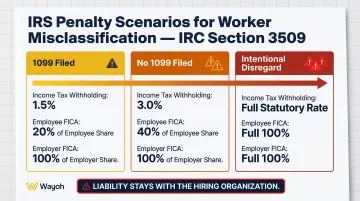
Staffing platforms that facilitate contractor relationships do not eliminate the hiring organization's classification liability. That responsibility stays with the company, regardless of how the engagement is structured.
The Real Cost of Non-Compliance for HealthTech Companies
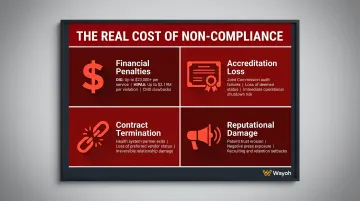
Financial Penalties
OIG Civil Monetary Penalties:
- Up to $23,000+ per item/service for employing excluded individuals
- Treble damages (3x the amount claimed)
- Example: West Bay Residential Services paid $325,000 for employing excluded individuals (2022)
HIPAA Violations:
- Penalties range from $145 to $2,190,294 per violation depending on culpability tier
- $144.9M in total settlements across 152 OCR enforcement cases to date
CMS Repayment Obligations:
- Claims rendered by ineligible providers must be repaid in full
- Multiplies rapidly for high-volume telehealth operations
Operational and Reputational Consequences
The financial exposure is only part of the picture. Operational and reputational damage can be harder to recover from:
- Accreditation loss: Failed Joint Commission audits can strip organizations of accreditation status
- Contract termination: Health system partners routinely end relationships when compliance failures surface
- Eroded patient trust: Publicized violations undermine the data security credibility that HealthTech platforms depend on
- Recruiting setbacks: Public compliance failures make it substantially harder to attract the senior clinical and compliance talent these organizations need most
How to Build a Compliant Healthcare Staffing Strategy
Step 1: Implement Continuous Monitoring Infrastructure Before Scaling
Select background check and credentialing vendors offering:
- Real-time OIG exclusion monitoring (monthly checks minimum)
- Automated license renewal tracking
- State-specific database integrations
Step 2: Establish Documentation Standards From Day One
Once monitoring infrastructure is in place, standardize what you're collecting. Requirements vary by role:
- Clinical roles: Proof of licensure, ongoing renewal tracking, OIG exclusion records, background screening results, HIPAA training completion, credentialing documentation
- Commercial roles: HIPAA training, background checks, any role-specific certifications
- Contractors: Classification documentation, agreements, ongoing monitoring records
Build centralized digital repositories with version control and audit-ready file structures before the first hire. The Joint Commission and CMS provide documentation guidance specific to telehealth organizations.
Step 3: Train People Teams on Sector-Specific Compliance
Compliance knowledge cannot sit only with legal teams — it must be embedded in recruiting and HR operations. That means training on:
- HIPAA obligations in the hiring workflow
- State telehealth licensing rules for each market
- Contractor classification criteria under federal and state law
- OIG exclusion monitoring procedures
- Credential verification standards
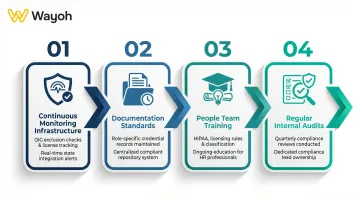
Step 4: Conduct Regular Internal Compliance Audits
Quarterly audits catch expired credentials, documentation gaps, and monitoring lapses before they surface in client or regulatory reviews. Assign an internal compliance lead — or partner with an external advisor who understands the HealthTech regulatory landscape — to own this function.
The OIG GCPG (2023) outlines seven elements of an effective compliance program, emphasizing that monitoring should be "regular and routine" with high-risk areas requiring daily or weekly monitoring.
Why the People You Hire Are Your First Line of Compliance Defense
For HealthTech companies, compliance isn't just a process problem—it's a talent problem. Hiring clinical professionals who don't understand multi-state licensing obligations, or compliance officers who lack HealthTech-specific regulatory knowledge (HIPAA in a digital product context, CMS rules for telehealth, FDA considerations for diagnostic tools), creates risk that no monitoring system can fully catch after the fact.
Finding the Right Regulatory Expertise
Candidates who have previously operated in regulated HealthTech environments—not just traditional healthcare—bring essential context that generalists simply don't have. The practical differences matter:
Candidates who have previously operated in regulated HealthTech environments—not just traditional healthcare—bring context that generalists simply don't have. The practical differences are significant:
- HIPAA in a digital health product involves data architecture decisions, API integrations, and vendor contracts — not just hospital privacy policies
- Multi-state telehealth licensing for a platform serving 30 states requires purpose-built infrastructure, not the manual tracking that works for a single clinic
- Building a compliance program inside a VC-backed company means documenting workflows and audit trails fast, without slowing down a team moving at startup speed
Finding these candidates requires recruiters who understand the difference through real conversations, not keyword matching. Wayoh's staffing approach is built specifically for this intersection: going network-first to surface professionals who have worked inside HealthTech compliance functions and understand the unique challenges of clinical regulation, digital delivery, and rapid scale.
That network-first approach covers both sides of the business: clinical hires (nurse practitioners and physicians who understand telehealth compliance) and commercial hires (regulatory affairs managers, compliance officers, and legal counsel who have navigated HealthTech-specific requirements). The professionals who can do this work well are rarely on job boards. They surface through years of sector relationships — which is exactly how Wayoh finds them.
Frequently Asked Questions
What is OIG exclusion monitoring, and does it apply to HealthTech companies?
OIG exclusion monitoring applies to any entity that employs individuals who interact with federal healthcare programs (Medicare/Medicaid), including many HealthTech companies. Monthly checks against the OIG exclusion list are best practice to avoid civil monetary penalties of $23,000+ per service.
How does HIPAA affect the hiring process for HealthTech organizations?
HIPAA governs how candidate and patient information is handled during screening, background checks, and onboarding. HealthTech HR teams must use secure, compliant platforms and train staff on privacy obligations even before a hire is made. Penalties range up to $2,190,294 per violation for willful neglect.
What are the risks of misclassifying a healthcare worker as an independent contractor?
Misclassification exposes organizations to back-pay, tax liability, and regulatory penalties under federal and state labor laws. The February 2026 Mochi Health class action reflects growing scrutiny of telehealth contractor models, especially in California and other ABC-test states.
Do telehealth companies need to verify licenses in every state where patients are located?
Yes. Clinical practitioners must hold valid licensure in each state where they provide care. While licensure compacts (IMLC covering 39 jurisdictions, NLC covering 43) simplify this for some specialties, many roles still require individual state-by-state verification. Counselors, social workers, and allied health professionals face particularly limited compact coverage.
What compliance documents should a HealthTech company maintain for each clinical hire?
Key records for each clinical hire include:
- Proof of licensure with ongoing renewal tracking
- Monthly OIG exclusion check records
- Background screening results
- HIPAA training completion certificates
- Role-specific credentialing documentation
The Joint Commission and CMS provide detailed documentation standards for telehealth organizations.
How can a HealthTech startup build a compliant staffing process without a dedicated compliance team?
Prioritize hiring a compliance-aware people operations lead early, implement credentialing and monitoring software from day one, and partner with staffing firms that have direct HealthTech regulatory experience. Multi-state licensing, HIPAA in a digital context, and compliance program building at startup scale all require specialized knowledge.