Introduction
Regulators aren't easing up. Global AML fines reached $6.6 billion in 2023 — a 57% year-over-year increase — and the TD Bank $3 billion BSA settlement in 2024 made clear that no institution is too large to face consequences for compliance gaps. Yet 80% of Chief Compliance Officers report staffing shortages in their compliance functions.
Fintechs are entering regulatory scope by the hundreds, competing directly with banks for the same limited pool of credentialed KYC professionals. Qualified candidates — CAMS-certified, experienced with CDD and EDD, familiar with FinCEN requirements — are off the market in as little as 10 days.
This guide covers the full picture: what KYC compliance teams actually require, why the hiring market is so constrained, which roles institutions are prioritizing, and how a specialized recruiter closes the gap faster than generalist alternatives.
Key Takeaways
- KYC programs demand regulatory knowledge, analytical judgment, and continuous monitoring across the full customer lifecycle
- Fintech growth and rising enforcement actions have accelerated demand well beyond the available talent supply
- Key roles include KYC Analysts, AML Analysts, KYC Case Managers, BSA Officers, and Compliance Managers
- Credentials matter, but hands-on CDD/EDD experience and platform familiarity matter just as much
- Specialized compliance recruiters fill KYC roles faster and with better-fit candidates than generalist firms
What KYC Risk Management Actually Demands from a Compliance Team
KYC isn't a one-time onboarding step. It's an ongoing due diligence framework that governs how institutions verify customer identity, assess financial crime risk, and monitor customer behavior across the entire relationship lifecycle. Every component requires people with distinct, specialized skills.
The Four Operational Pillars
Every KYC program must execute across four core areas:
- Customer Identification Program (CIP) — Collecting and verifying the minimum four data points (name, date of birth, address, identification number) at account opening, as required under USA PATRIOT Act Section 326
- Customer Due Diligence (CDD) — Building risk-based customer profiles, understanding the nature and purpose of relationships, and monitoring for suspicious transaction patterns
- Enhanced Due Diligence (EDD) — Applying deeper investigation to high-risk customers, including politically exposed persons (PEPs), customers from high-risk jurisdictions, and entities with complex ownership structures
- Ongoing Transaction Monitoring — Continuously reviewing transaction activity against established risk profiles to detect and report suspicious behavior
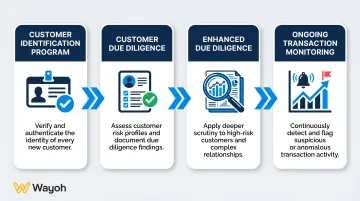
EDD is where specialist analyst judgment becomes most consequential. PEPs require senior management approval, source-of-wealth verification, and enhanced ongoing monitoring per FATF Recommendation 12. Entities with layered ownership structures require analysts who can trace beneficial ownership chains, map corporate relationships, and escalate with documented rationale that holds up under regulatory examination.
Beneficial Ownership and Sanctions Screening
Beyond the four pillars, two specific areas have drawn sustained regulatory attention and require their own staffing considerations:
- Beneficial ownership verification: Under FinCEN's CDD Rule (31 CFR 1010.230), institutions must identify every individual owning 25% or more equity in a legal entity customer, plus one individual with significant management control. This requires analysts who understand corporate structures and can document ownership chains under exam conditions.
- Sanctions screening: OFAC compliance requires real-time screening against the Specially Designated Nationals (SDN) list. Analysts must understand how to resolve false positives and escalate genuine matches.
The Shift Toward Perpetual KYC
ACAMS defines perpetual KYC (pKYC) as maintaining accurate client data through near real-time updates based on behavioral changes. Rather than reviewing customer risk profiles on fixed annual cycles, institutions are moving toward continuous monitoring that flags changes as they happen.
For hiring teams, this shift has a direct consequence: KYC analysts now need to operate comfortably alongside automated monitoring tools, not just regulatory frameworks. Professionals who can interpret system-generated alerts and translate them into defensible decisions are increasingly hard to find — and increasingly essential.
Why Hiring Qualified KYC Professionals Is More Difficult Than Ever
The talent shortage in KYC compliance isn't cyclical — it's structural. Demand is expanding faster than the qualified candidate pool can grow, and several converging pressures explain why.
Regulatory Expansion Keeps Adding Headcount Requirements
Every update to the core frameworks — the Bank Secrecy Act, FinCEN CDD Rule, FATF Recommendations, and the EU's 6th Anti-Money Laundering Directive (entering application in July 2027) — requires compliance teams to either upskill existing staff or add new headcount to remain audit-ready.
The BSA Officer designation isn't discretionary. It's a statutory requirement under 31 U.S.C. 5318(h)(1)(B), and every covered financial institution must fill that role.
Fintechs Are Competing for the Same Candidates
Fintech risk and compliance hiring surged 26%, with fintechs overtaking traditional banks in compliance recruitment volume. Neobanks, payment processors, crypto platforms, and embedded finance companies are all becoming regulated entities. Across 47 states plus DC that require money transmitter licenses, many are hiring KYC talent for the first time.
Every one of them is drawing from the same limited candidate pool that banks have always relied on — and that pool hasn't grown to match the demand.
The Credential Bottleneck Is Real
Meaningful KYC roles typically require:
- CAMS certification (Certified Anti-Money Laundering Specialist) — ACAMS has 100,000 members globally, but the BLS reports 418,000 compliance officers in the U.S. alone
- Hands-on CDD/EDD experience in environments that have faced actual regulatory examination
- Platform familiarity with tools like NICE Actimize or Fiserv AML Risk Manager
- Years of experience building that combination — none of it can be fast-tracked
Enforcement Actions Have Eliminated Tolerance for Compromise
According to Fenergo's 2024 AML enforcement report, global AML fines totaled $4.6 billion in 2024, with cumulative penalties exceeding $69 billion since 2007. The TD Bank settlement alone — $3 billion — was the largest-ever BSA penalty.
Compliance executives hiring under that scrutiny cannot afford to settle on candidate quality. The pressure doesn't ease once a hire is made, either:
- A 42% AML professional burnout rate means experienced staff leave faster than they can be replaced
- Chronic understaffing forces remaining analysts to absorb more cases — raising error risk exactly when regulators are watching
Key KYC Roles Banks and Fintechs Are Actively Hiring
KYC Analyst and AML Analyst
KYC Analysts execute the front-end of the compliance process: collecting and verifying customer documentation, completing CIP and CDD workflows, assigning initial risk ratings, and escalating complex profiles for further review.
AML Analysts work downstream, monitoring transactions for suspicious activity, filing Suspicious Activity Reports (SARs), and supporting alert-triggered investigations. Both are the most commonly hired entry-to-mid-level compliance roles. Candidates need:
- Solid grasp of AML typologies and regulatory requirements
- Hands-on experience with transaction monitoring platforms
- Ability to distinguish routine activity from genuine red flags
KYC Analyst salaries in New York average $100,677 annually, reflecting the market's recognition that these roles require genuine regulatory knowledge, not just procedural execution.
Wayoh recruits KYC Analysts and AML Analysts across banking and fintech clients as core volume roles — including both active candidates and passive professionals who aren't circulating on job boards.
KYC Case Manager
When a high-risk customer review stalls, it usually traces back to one gap: no one owns the case end-to-end. A KYC Case Manager fills that gap, coordinating between front office, compliance, and legal teams; managing EDD investigations; and ensuring cases are documented and resolved within regulatory timelines.
This role sits between analyst execution and compliance leadership. It demands:
- Strong analytical judgment under deadline pressure
- Working knowledge of beneficial ownership structures
- Experience managing competing case volumes simultaneously
- Ability to produce regulatory-defensible documentation
For institutions processing high volumes of complex customers — or facing remediation backlogs — this role is often the operational bottleneck when left unfilled.
BSA Officer and Compliance Manager
These are the senior leadership roles that determine whether an institution's KYC program withstands regulatory examination.
The two roles serve distinct functions:
| Role | Core Responsibility | Salary Range |
|---|---|---|
| BSA Officer | Owns the full AML/KYC program: policies, controls, SAR filing, and direct regulator accountability. Required by law under the Bank Secrecy Act. | National avg. $98,949; ACAMS-certified CCOs: $155,000–$200,000 |
| KYC Compliance Manager | Bridges analyst teams and BSA leadership, managing workflows, reviewing escalations, and interfacing with examiners during regulatory reviews. | Varies by institution size and scope |
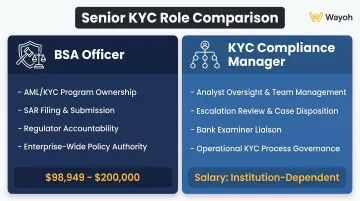
Fintechs building compliance functions from scratch need a different profile than candidates who've operated within established bank programs. The ability to design a program — write policies, select technology, define escalation workflows — is as important as the ability to run one. Wayoh works with fintech companies from Seed to Series C on these foundational hires, helping founders define the role before going to market.
What to Look for When Screening KYC Candidates
Credentials Worth Verifying
| Certification | Issuing Body | Best For |
|---|---|---|
| CAMS | ACAMS | Primary AML/KYC roles across all levels |
| CKYCA | ACAMS | KYC-specific analyst and specialist roles |
| CFCS | ACFCS | Investigation-focused financial crime roles |
| CAFCA | ACAMS | Fintech compliance professionals |
| CGSS | ACAMS | Sanctions-specialist roles |
Certifications confirm foundational knowledge — but not depth. A candidate with a CAMS and two years at a low-scrutiny community bank looks very different from one who's navigated a consent order or regulatory examination at a major institution. Verify both.
Regulatory Fluency Over Generic "Compliance Experience"
A strong KYC candidate should articulate specific familiarity with:
- Bank Secrecy Act requirements and reporting obligations (SARs, CTRs)
- FinCEN CDD Rule beneficial ownership thresholds and documentation requirements
- OFAC sanctions screening protocols and false positive resolution
- For fintech roles: applicable state money transmitter regulations
Candidates who have personally navigated a regulatory examination — preparing documentation, responding to examiner questions, implementing remediation — bring institutional knowledge that cannot be replicated through coursework alone.
Technology Literacy as a Screening Criterion
Over 70% of banks in developed markets are replacing legacy KYC systems with automated platforms. The KYC software market is growing at a 24.8% CAGR. Candidates experienced with NICE Actimize, Fiserv AML Risk Manager, or comparable onboarding automation tools shorten ramp-up time considerably — often by weeks.
For fintech roles specifically, experience integrating KYC workflows into digital product environments (not just operating within them) separates candidates who can build from those who can only follow.
How a Specialized KYC Recruiter Gives Your Institution a Hiring Edge
Generalist job boards and general recruiting firms have a consistent limitation in this market: they can source resumes but can't assess regulatory knowledge depth. They can't distinguish a BSA Officer who has managed examinations from one who has operated only in low-scrutiny environments. In compliance hiring, that distinction determines whether you pass your next regulatory exam. That's the gap a specialized recruiter fills.

What Wayoh Brings to KYC Hiring
Wayoh has placed 500+ compliance, risk, and legal professionals across regulated industries over more than 3 years — with KYC Analysts, AML Analysts, BSA Officers, Transaction Monitoring Specialists, and Sanctions Analysts among the core role types regularly placed across banking and fintech clients.
Rooted in a human-first recruiting philosophy, recruiting in this space runs on relationships, not resume databases:
- Passive candidate access: Strong KYC professionals rarely browse job boards. Wayoh reaches them through direct outreach and long-term market relationships
- Regulatory depth in screening: Candidate evaluation includes direct conversations about regulatory exposure, platform experience, and hands-on CDD/EDD backgrounds — not just credential verification
- Coverage in key hiring hubs: Wayoh operates across New York, San Francisco, and broader California markets where KYC talent concentrates and competition is most intense

Flexibility for Fluctuating Compliance Headcount
KYC staffing needs don't follow a straight line. Regulatory remediation projects, product launches, M&A activity, and onboarding volume surges all create temporary headcount requirements that don't justify permanent hires.
Wayoh supports both models:
- Permanent placement for BSA Officers, Compliance Managers, and strategic analyst hires
- Interim and contract staffing for remediation projects, onboarding backlogs, regulatory audits, and system transitions
All contractors are vetted through references and background checks before placement, with transparent conversion terms from day one. This lets institutions scale compliance teams in response to demand without overcommitting to permanent headcount during uncertain regulatory cycles.
Frequently Asked Questions
What are the 4 steps of KYC?
The four components are Customer Acceptance Policy (CAP), Customer Identification Program (CIP), Customer Due Diligence and Transaction Monitoring, and Risk Management. Each step requires personnel with distinct skills — from identity verification at onboarding through ongoing behavioral monitoring.
What are the main types of risk in KYC?
Core KYC risk categories include:
- Identity and fraud risk
- Transaction and behavioral risk
- Geographic risk from high-risk jurisdictions
- Reputational, legal, and regulatory risk
Each category shapes how compliance teams set monitoring thresholds, escalation protocols, and EDD triggers.
What laws and standards govern KYC requirements?
In the U.S., the primary frameworks are the Bank Secrecy Act, FinCEN CDD Rule (31 CFR 1010.230), and USA PATRIOT Act Section 326. Internationally, FATF Recommendations and EU AML Directives apply.
What is case management in AML and what does a KYC case manager do?
AML case management is the process of investigating, documenting, and resolving flagged alerts or high-risk customer reviews. A KYC Case Manager owns this workflow end-to-end — coordinating across compliance, legal, and front office teams to ensure timely resolution with regulatory-defensible documentation.
How do you mitigate risk in KYC?
Core mitigation strategies include:
- Risk-tiered customer segmentation
- Enhanced due diligence for high-risk profiles
- Continuous transaction monitoring
- Regular program reviews and independent audit testing
What are the KYC norms for banks?
U.S. banks are required to implement a written AML/KYC program covering five pillars: internal policies and controls, a designated BSA compliance officer, an ongoing employee training program, independent audit testing, and Customer Due Diligence procedures — as mandated by FinCEN and the Bank Secrecy Act.