Healthtech firms face a more complex version of this challenge than traditional healthcare providers. PHI flows through APIs, cloud databases, SaaS platforms, and third-party integrations — not just clinical workflows. Finding a compliance officer who understands both the regulatory landscape and the technology stack is harder than most hiring managers expect. This guide covers what to look for, how to structure the hiring process, and where specialist recruiting support makes a measurable difference.
Key Takeaways
- A HIPAA Compliance Officer is a legally required designation for covered entities and business associates handling PHI
- Healthtech candidates must combine regulatory expertise with direct experience in SaaS, cloud, and EHR/API environments
- Prioritize risk assessment ownership, breach response history, and cross-functional communication skills — not just certifications
- Scenario-based evaluations reveal more than credential checks alone
- A specialist recruiter with healthtech compliance experience reduces time-to-hire and improves candidate quality
What Is a HIPAA Compliance Officer?
A HIPAA Compliance Officer is a formally designated role, required under federal law, responsible for ensuring an organization complies with the HIPAA Privacy Rule, Security Rule, and Breach Notification Rule. Both covered entities and business associates must make this designation — or face direct regulatory exposure.
Privacy Officer vs. Security Officer
The two roles have distinct mandates under separate CFR sections:
- Privacy Officer (45 CFR §164.530): Oversees how PHI is used, disclosed, and protected from a policy and patient-rights standpoint
- Security Officer (45 CFR §164.308): Responsible for safeguarding electronic PHI (ePHI) through technical and administrative controls
In smaller healthtech firms, one person commonly holds both designations. That's permitted — HIPAA doesn't require separate individuals — but it does require the person to be genuinely competent across both areas.
Understanding these role boundaries matters — because in healthtech, how those responsibilities play out in practice looks very different from traditional healthcare settings.
The Healthtech Difference
A compliance officer who spent a decade in a hospital system may not be the right fit for a healthtech platform. In clinical environments, PHI moves through EHRs and care workflows. In healthtech, it flows through APIs, cloud databases, mobile apps, and third-party vendor integrations — each carrying its own compliance obligations.
The right candidate must be fluent in both the regulatory requirements and the technical architecture of the product. That's a narrower talent pool than most hiring teams expect.
Key Qualifications to Look For
The qualifications that matter for a healthtech HIPAA Compliance Officer differ meaningfully from those for a payer or hospital. Evaluate accordingly.
Regulatory and Legal Foundation
At minimum, the candidate should demonstrate working knowledge of:
- The HIPAA Privacy Rule, Security Rule, and Breach Notification Rule
- The HITECH Act and the 2013 Omnibus Final Rule, which extended direct liability to business associates
- The distinction between covered entities and business associates, and which BAAs need to be executed across a typical healthtech vendor stack
For firms operating in California, New York, or other states with stricter data privacy laws, also verify familiarity with the California CMIA, CCPA/CPRA, and the New York SHIELD Act. These statutes add notification and security obligations that layer on top of federal HIPAA requirements — and they apply to data flows that healthtech platforms handle daily.
Healthcare Technology Fluency
Many otherwise qualified candidates stumble here. PHI in healthtech doesn't sit in a filing cabinet — it moves through APIs, gets stored in cloud databases, and is processed by third-party tools that each carry their own risk surface.
Look for candidates who have directly:
- Audited or governed cloud-hosted health data platforms
- Managed compliance programs in SaaS development environments
- Implemented PHI access controls in software pipelines
- Assessed vendor and third-party risk in technology ecosystems
A candidate whose experience is limited to traditional clinical settings may struggle to govern the distributed, API-driven environments healthtech firms actually run — and that gap carries real operational risk.
Risk Assessment and Incident Response Experience
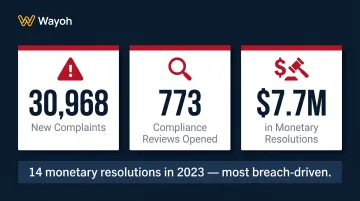
HHS mandates that covered entities and business associates conduct an accurate and thorough Security Risk Analysis under 45 CFR §164.308(a)(1)(ii)(A). OCR treats this as foundational — and their enforcement data shows how often it fails.
Per the HHS OCR 2023 Annual Report, OCR received 30,968 new complaints and opened 773 compliance reviews — most breach-driven — resulting in 14 monetary resolutions totaling $7.7 million.
Ask candidates directly:
- Have they owned a Security Risk Analysis from scoping through documentation?
- Have they managed an OCR investigation or corrective action plan?
- Have they redesigned a control framework after a security event?
- Have they executed HIPAA breach notification workflows, including notifying affected individuals?
Candidates with only theoretical knowledge of these processes — rather than direct ownership — can leave your organization exposed during an OCR investigation.
Certifications Worth Evaluating
No government-issued HIPAA certification exists, and HHS does not require one. Treat industry credentials as validation of foundational knowledge, not as a substitute for experience.
| Credential | Issuing Body | Relevance |
|---|---|---|
| CHC | HCCA / CCB | Compliance program design and healthcare regulatory oversight |
| CHPS | AHIMA | Privacy and security program administration in healthcare |
| CISSP | ISC2 | Information security leadership for ePHI environments |
| CISM | ISACA | Security management, risk, and governance for ePHI |
A candidate with a CHPS and zero breach response experience is less valuable than one with hands-on incident history and no credential at all.
Cross-Functional Communication
A HIPAA Compliance Officer who only writes policy documents and sends enforcement emails will struggle in a healthtech environment. The role requires translating complex regulatory requirements into language that engineers, product managers, and executives can act on.
During interviews, evaluate whether the candidate can:
- Explain a HIPAA control requirement in terms a developer would understand
- Design and deliver workforce training that actually changes behavior
- Frame compliance as a business asset — not just a legal obligation
At growth-stage healthtech firms, a compliance officer who can speak to enterprise buyers — and help close deals rather than stall them — is a direct revenue asset, not just a risk function.
How to Structure the Hiring Process
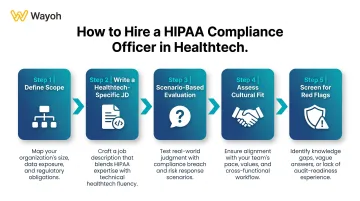
Many healthtech firms approach HIPAA Compliance Officer hiring the same way they'd hire a senior manager — resume screen, a few interviews, a credentials check. That process misses what makes this role different. The five steps below are designed to close that gap.
Step 1: Define the Scope Before Posting
Before writing a job description, answer these questions:
- Do you need a Privacy Officer, Security Officer, or a combined role?
- Who does this person report to — CTO, COO, or General Counsel?
- Is this a standalone function or part of a broader compliance or legal team?
- Is this a permanent hire or an interim placement to cover a gap or audit?
These decisions shape the candidate profile, compensation range, and what a realistic shortlist looks like.
Step 2: Write a Healthtech-Specific Job Description
Generic healthcare JD templates will attract the wrong candidates. Your job description should explicitly reference:
- BAA management with technology vendors
- Oversight of PHI handling in cloud environments
- Compliance controls in software development (access logging, encryption standards, SDLC governance)
- Experience with SaaS compliance programs or API-connected health data platforms
This narrows the applicant pool to candidates who have actually operated in your environment — not just a hospital.
Step 3: Use Scenario-Based Evaluation
Resume reviews and credential checks tell you what someone has done. Scenarios tell you how they think. Build evaluation questions around real healthtech compliance challenges — for example:
- "Walk me through how you'd respond to a PHI exposure through an API vulnerability."
- "How would you design a HIPAA training program for a 50-person engineering team that's never worked in healthcare before?"
- "Describe how you've balanced compliance requirements with product velocity at a growth-stage company."
These questions separate candidates with genuine operational experience from those who've only read the regulations.
Step 4: Assess for Cultural and Strategic Fit
The HIPAA Compliance Officer will need to build a compliance-first culture, not just enforce rules. In interviews, pay attention to how candidates frame the role:
- Do they position compliance as a business enabler — supporting enterprise deals, building client trust, reducing insurance costs?
- Or do they describe it primarily in terms of enforcement and prohibition?
In growth-stage healthtech, the first mindset unlocks revenue. The second creates friction.
Step 5: Watch for Red Flags
Common disqualifiers worth screening for:
- Relies entirely on templates and checklists without demonstrating adaptive judgment
- Has never managed a real breach, OCR inquiry, or corrective action plan
- No direct experience in software, SaaS, or cloud environments
- Cannot articulate how they've influenced organizational behavior — only that they've written policies
- Frames every compliance question as a legal restriction rather than a risk management decision
How Wayoh Can Help Healthtech Firms Hire the Right HIPAA Compliance Officer
Finding a HIPAA Compliance Officer who understands both the regulatory framework and the technical realities of healthtech is a narrow search. Wayoh specializes in exactly this — placing compliance, risk, and legal professionals in regulated industries, with 500+ placements over more than 3 years and a human-first, relationship-led model that reaches candidates who aren't actively on the market.
Screening goes deeper than credentials. Wayoh conducts direct conversations with candidates to assess technical fit, leadership style, and hands-on compliance experience. For healthtech roles, that means evaluating candidates on their familiarity with digital health environments, PHI handling in cloud and API contexts, data privacy programs, and cross-functional compliance work.
Wayoh supports healthtech clients across the full hiring spectrum:
- Permanent placements for long-term compliance leadership, including combined Privacy/Security Officer roles
- Interim placements for compliance gaps, audit support, remediation work, or regulatory urgency
- Executive search for senior compliance leadership at growth-stage firms building compliance functions from the ground up

Wayoh maintains active networks across New York, California, and Florida, with nationwide reach for distributed teams. The focus is on candidates who have worked inside healthtech compliance environments — not those transitioning from traditional clinical or hospital settings. For growth-stage companies making a foundational compliance hire, that difference in candidate background typically accelerates both onboarding and program execution.
Conclusion
A weak HIPAA Compliance Officer hire isn't a gap you can patch later. The right person protects PHI, enables enterprise partnerships, and builds credibility with clients and regulators. The wrong one creates regulatory exposure that costs far more to remediate than to prevent. OCR's enforcement record — over $130 million in penalties collected since 2003 — confirms that risk is real.
Regulatory pressure isn't easing. HHS guidance on AI in healthcare, 21st Century Cures Act interoperability requirements, and expanding state privacy laws are already reshaping what compliance officers need to know. The right hire understands where the rules are heading, not just where they stand today. For healthtech firms building toward scale, that forward-looking capability is what separates a compliance officer from a compliance liability.
Frequently Asked Questions
What does a HIPAA compliance officer do?
A HIPAA Compliance Officer oversees an organization's compliance with the Privacy Rule, Security Rule, and Breach Notification Rule — including policy development, workforce training, Security Risk Analyses, and incident response. In healthtech, this also covers ePHI handled through software platforms, APIs, and third-party vendor integrations.
Is it required by HIPAA to have a privacy officer?
Yes. Under 45 CFR §164.530(a)(1), covered entities must designate a Privacy Officer; under 45 CFR §164.308(a)(2), both covered entities and business associates must designate a Security Officer. Smaller organizations can assign both roles to one person, but the formal designation is legally required.
Who can be a HIPAA privacy officer?
HIPAA does not prescribe specific credentials or a minimum qualification level — the role can be filled by an existing employee, a new hire, or an outsourced consultant. The individual must, however, have sufficient knowledge of HIPAA rules and the organization's operations to actually fulfill the responsibilities.
What are the four most common HIPAA violations?
OCR consistently cites: impermissible use or disclosure of PHI, lack of adequate safeguards for ePHI, failure to conduct a Security Risk Analysis, and insufficient workforce training.
How do I obtain a HIPAA certification?
There is no government-issued HIPAA certification — HHS does not require one. Recognized industry credentials include the CHC (Certified in Healthcare Compliance) from HCCA and the CHPS (Certified in Healthcare Privacy and Security) from AHIMA. Treat these as one signal among several, not the primary hiring criterion.
What are the 5 main HIPAA rules?
The five rules are: the Privacy Rule, the Security Rule, the Breach Notification Rule, the Enforcement Rule, and the Omnibus Final Rule (2013). In healthtech, all five interact across data practices, vendor relationships, and software architecture — so operational command of each is essential.