Most banks understand how credit risk management is supposed to work. The harder question is whether their teams are actually equipped to execute it. That gap between policy and personnel is where institutions get into trouble.
This post covers what credit risk management involves in a banking context, the specific roles that carry it out, the skills that distinguish top performers, and practical strategies for building a stronger hiring approach.
Key Takeaways
- Credit risk management covers identifying, measuring, and controlling borrower default risk — with regulators like the OCC, Federal Reserve, and FDIC setting the bar.
- Execution depends on distinct roles — credit analysts, portfolio managers, model validators, compliance officers, and the CRO.
- The talent pool is genuinely shallow: only 60,500 financial risk specialists work in the U.S., and demand is growing at 6% annually.
- Fintech credit risk hiring grew nearly 200% while bank hiring fell 1% — banks are competing harder than ever for a shrinking candidate pool.
- Specialized recruiters with deep market relationships reach passive candidates that job boards can't.
What Credit Risk Management Means for a Bank
The Basel Committee defines credit risk as "the potential that a bank borrower or counterparty will fail to meet its obligations in accordance with agreed terms." In April 2025, the Committee published its first revision to credit risk management principles in 25 years — covering how supervisors evaluate a bank's credit risk environment, credit-granting process, monitoring practices, and internal controls.
The End-to-End Process
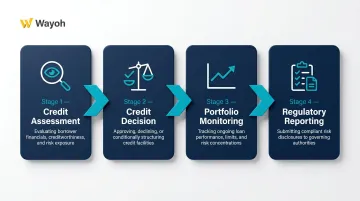
Commercial banks manage credit risk across four stages, each requiring distinct expertise:
- Credit assessment — Evaluating borrower financials, applying risk rating models, and scoring creditworthiness
- Credit decision — Structuring loan terms, pricing risk, and approving or declining credit
- Portfolio monitoring — Tracking exposure, detecting early warning signals, and flagging deteriorating credits
- Regulatory reporting — Documenting ACL methodology, risk ratings, and concentration analysis for examiners
Three Types of Credit Risk
| Risk Type | Definition | Staffing Implication |
|---|---|---|
| Default risk | Borrower fails to repay | Needs analysts with strong credit judgment |
| Concentration risk | Overexposure to one borrower, sector, or geography | Needs portfolio managers with macro view |
| Country/transfer risk | Political or economic instability affecting repayment | Needs specialists familiar with cross-border exposure |
The 5 Cs Framework
Understanding the risk types above helps clarify what your candidates actually need to know. Every credit professional evaluates borrowers through five factors: Character (intent to repay), Capacity (ability to service debt), Capital (net worth and leverage), Collateral (assets pledged), and Conditions (economic environment and loan purpose). Fluency with this framework is a baseline expectation for any credit risk hire — treat it as the floor, not a selling point, when screening candidates.
Key Roles Inside a Bank's Credit Risk Function
Chief Risk Officer (CRO)
The CRO sets risk appetite, oversees governance, and maintains direct access to the board and regulators. Per the OCC's Corporate and Risk Governance handbook, the CRO leads Independent Risk Management and must have "unfettered access to the board or its risk committee."
According to Bank Director, 96% of banks over $10 billion in assets have a dedicated CRO, and 81% report directly to the CEO. Banks typically begin evaluating the need for a dedicated CRO as they approach $1 billion in assets — and it's consistently one of the most difficult searches in financial services.
Credit Risk Analyst (Junior to Senior)
The core analytical role. Responsibilities include:
- Building credit assessments and financial statement analyses
- Applying internal risk rating models
- Monitoring loan portfolios for early warning indicators
- Supporting credit committee presentations
Strong analysts combine quantitative ability with genuine credit judgment. The two don't always arrive in the same candidate.
Credit Portfolio Manager
This role oversees the composition and health of the bank's loan book. Portfolio managers monitor concentration risk, set exposure limits, and recommend adjustments to senior leadership. The profile requires a macro view of credit exposure, comfort with ambiguity, and the ability to operate at the intersection of risk and strategy. Key focus areas include:
- Concentration risk monitoring across industries and geographies
- Exposure limit-setting and escalation frameworks
- Communicating portfolio health to senior leadership and credit committees
Quantitative Risk Analyst / Model Validator
Builds and validates the statistical models — PD, LGD, and EAD — that underpin credit decisions, stress testing, and Basel capital calculations. The role demands advanced quantitative skills (Python, SAS, R, SQL) and deep familiarity with IRB methodology.
Candidates who can both construct models and credibly challenge them are scarce. It's one of the thinnest talent pools in banking risk.
Credit Risk Compliance Officer
Bridges the credit risk function and regulatory compliance. This role ensures that practices meet OCC, Federal Reserve, and CFPB requirements, that policies are documented, and that the function is audit-ready. As examiners increasingly scrutinize ACL methodology and risk rating consistency, the compliance officer's role has grown more consequential.
Skills and Qualifications of Top Credit Risk Professionals
Technical and Quantitative Skills
Top candidates demonstrate hands-on experience with:
- Financial statement analysis and credit risk rating methodologies
- PD (Probability of Default), LGD (Loss Given Default), and EAD (Exposure at Default) — the core components of Basel IRB capital calculations
- Loan portfolio analytics and early warning detection
- Tools including Python, SQL, SAS, R, and Excel-based credit models
The 2024 GARP Risk Careers Survey found 54% of risk professionals cite technology skills as vital — a meaningful shift from five years ago.
Regulatory Knowledge
Candidates who understand the regulatory environment are significantly more valuable. Look for familiarity with:
- Basel III/IV capital requirements and IRB methodology
- OCC credit risk guidance and ACL documentation standards
- DFAST/CCAR stress testing frameworks (mandatory for firms with $100B+ in assets)
The ongoing Basel III endgame — with U.S. agencies releasing proposed capital rule changes in March 2026 — continues to generate demand for specialists who can model and interpret new requirements across all bank size categories.
Judgment, Communication, and Cross-Functional Skills
Credit risk professionals don't just build models in isolation. The best ones:
- Present findings to credit committees and executive leadership
- Communicate risk positions clearly to non-technical stakeholders
- Challenge model outputs when results don't align with portfolio reality
- Influence underwriting decisions across business lines
The GARP survey found 66% of professionals cite interpersonal communication and presentation skills as essential for career progression.
Credentials Worth Recognizing
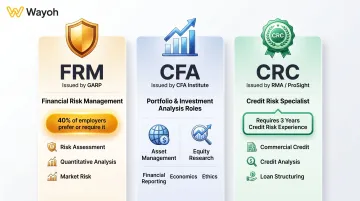
| Credential | Issuer | Relevance |
|---|---|---|
| FRM (Financial Risk Manager) | GARP | 40% of employers prefer or require it in postings |
| CFA (Chartered Financial Analyst) | CFA Institute | Strong for portfolio-level and investment analysis roles |
| CRC (Credit Risk Certification) | RMA / ProSight Financial | Requires 3 years of credit risk experience; directly applicable |
Advanced degrees in finance, economics, or statistics are common at the senior level. Hands-on regulatory experience — particularly for roles touching ACL, stress testing, or Basel compliance — often matters more than the degree itself.
Why Hiring Credit Risk Talent Is Harder Than It Looks
A Shallow Talent Pool
The BLS reports 60,500 financial risk specialists employed nationally, with a median wage of $106,000. That's a relatively small pool for a function that touches every lending institution in the country. Banks targeting senior analysts, portfolio managers, and model validators are often competing for the same 50 people in their market.
Qualified credit risk professionals must combine quantitative ability, regulatory knowledge, lending experience, and communication skills. Finding all four in one candidate is rare.
Fintech Is Winning the Talent Competition
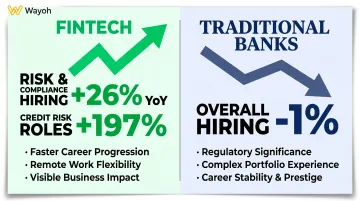
Morgan McKinley's 2025 Risk and Compliance Report found fintech risk and compliance hiring surged 26% year-over-year, while traditional bank hiring fell 1%. Credit risk roles in fintech grew by nearly 200%.
Fintechs draw candidates with:
- Faster career progression and higher base compensation
- Greater scheduling flexibility and remote work options
- Leaner organizational structures with more visible impact
Banks need to articulate a different value proposition — regulatory significance, portfolio complexity, career stability — rather than trying to win on compensation alone.
Regulatory Change Creates Persistent Demand
Post-2008 reforms permanently elevated the compliance burden on bank credit functions. Basel IV implementation, OCC examination priorities, and periodic updates to ACL methodology create recurring demand spikes for specialists who understand the requirements. Hiring teams rarely get a quiet window — demand resets with every regulatory update cycle.
The Cost of Getting It Wrong
A poor hire in a regulated credit function isn't just an HR problem. Veremark research puts the fully loaded cost of a bad hire in regulated finance at 8x to 15x salary, driven by regulatory consequences and compliance remediation — not just recruitment costs. That exposure is amplified precisely because of the regulatory complexity described above.
Add to that the ramp-up reality: senior credit risk hires typically need 3–6 months to reach full productivity given the complexity of internal systems, loan portfolios, and examiner relationships. Nearly 40% of senior-level roles take more than 90 days to fill, according to Mitratech's 2025 benchmark analysis. Planning for that timeline — and getting the hire right — isn't optional.
How Banks Can Recruit Top Credit Risk Professionals More Effectively
Define the Role Before You Post It
The most common mistake: a single job description that conflates four different profiles. Before posting, clarify whether you need:
- A generalist credit analyst with strong underwriting fundamentals
- A quantitative model builder with IRB and statistical modeling experience
- A regulatory compliance specialist focused on ACL and examiner readiness
- A portfolio-level strategist who can manage concentration risk at a macro level
Conflating these profiles leads to mismatched candidates, extended timelines, and wasted interviewing capacity.
Evaluate for Judgment, Not Just Credentials
The most predictive interviews go beyond résumé review. Ask candidates to walk through:
- A credit decision they influenced and what they weighted in the analysis
- A risk position they escalated and how they communicated it
- A model output they challenged and why their instinct was right (or wrong)
Structured competency interviews and scenario-based assessments surface judgment in ways that credential screening can't. An FRM or CRC is a useful signal — it's not a substitute for tested credit thinking.

Partner with a Specialized Financial Services Recruiter
Senior credit risk professionals are rarely active job seekers. They're employed, busy, and not browsing job boards. Even the best internal recruiting teams struggle to reach this audience — and that's where external partnerships earn their value.
Wayoh's human-first recruiting model is built on direct outreach and market relationships developed over 10+ years in financial services staffing. With 500+ placements across banking, fintech, and healthtech, the firm reaches passive candidates that standard sourcing methods miss. Interim staffing is available for urgent coverage gaps, with transparent conversion terms from day one. Executive searches are handled with discretion when confidentiality is a priority.
Frequently Asked Questions
Who is responsible for credit risk management in banks?
Responsibility is distributed across the credit risk function, with the Chief Risk Officer holding ultimate accountability. Credit analysts, portfolio managers, model validators, and compliance officers each play distinct roles across origination, monitoring, and regulatory reporting.
What is the credit risk management process in commercial banks?
The process runs across four sequential stages:
- Credit assessment — evaluating the borrower's financial profile and risk
- Credit decision and loan structuring — approving, pricing, and documenting the facility
- Portfolio monitoring — tracking early warning signals across active exposures
- Regulatory compliance reporting — meeting capital and disclosure requirements
Each stage requires distinct expertise and documentation.
What is credit risk management in a bank?
It's the practice of identifying, measuring, and controlling the risk that borrowers will fail to meet repayment obligations — to maximize risk-adjusted returns while staying within the bank's regulatory capital constraints and risk appetite.
What are the three types of credit risk in banks?
Default risk (borrower fails to repay), concentration risk (overexposure to one borrower, sector, or geography), and country risk (geopolitical or economic instability affecting cross-border repayment capacity). Each type shapes which specialists a bank needs on staff.
What are the 5 Cs of credit risk management?
Character, Capacity, Capital, Collateral, and Conditions. These five factors form the framework credit professionals use to evaluate a borrower's likelihood of repayment.
What is EAD vs PD vs LGD?
These are the three components of credit loss modeling under Basel's IRB approach. Probability of Default (PD) measures likelihood of default, Loss Given Default (LGD) measures the percentage lost if default occurs, and Exposure at Default (EAD) measures the outstanding amount at default. Together: EL = PD × LGD × EAD.