Introduction
U.S. banking regulators issued 277 enforcement actions in 2024 — a 34.5% increase from 206 actions in 2023, with total monetary sanctions climbing from $20.1 billion to $24.6 billion. The October 2024 TD Bank case brought the stakes into sharp focus: a record $1.3 billion FinCEN penalty, combined with DOJ charges, produced a $3 billion total fine — driven largely by chronic underinvestment in AML staffing.
The compliance hiring problem is straightforward: regulatory demands are growing more complex, but the pool of qualified professionals isn't keeping pace.
Generic job postings and generalist recruiters can fill seats. But they rarely surface candidates with the regulatory depth banks need — and in this space, a hiring mismatch isn't just an operational headache. It's an enforcement liability.
This guide breaks down the roles, qualifications, and hiring strategies that help banks staff compliance and risk functions before regulators come knocking.
TLDR: Bank Compliance and Risk Hiring at a Glance
- AML, KYC, credit risk, operational risk, and regulatory reporting each demand distinct expertise — one generalist hire rarely covers it
- Enforcement actions rose 34.5% in 2024, making compliance staffing a strategic obligation, not a back-office function
- Six roles anchor most compliance programs: CCO, CRO, BSA/AML Officer, Compliance Manager, Risk Analyst, and Regulatory Affairs Specialist
- Screen for CAMS (AML), CRCM (compliance management), FRM/PRM (risk), and CFE (fraud) as credential benchmarks
- Specialist recruiters with regulated-industry networks fill vetted compliance roles faster than traditional hiring channels
What Is Bank Regulation Risk Management and Compliance?
Per the OCC, compliance risk is "the risk to a bank's current or projected financial condition and resilience arising from violations of laws or regulations or from nonconformance with prescribed practices." That definition anchors everything from hiring decisions to program design.
Compliance risk management is the process of identifying, assessing, and mitigating those risks. It's narrower than enterprise risk management, which also covers credit, market, and operational exposures — but in practice, these functions overlap considerably and require coordinated staffing.
The Four Primary Risk Types
| Risk Type | Focus | Why It Needs Dedicated Oversight |
|---|---|---|
| Compliance Risk | Adherence to laws, regulations, internal policies | Regulatory penalties, enforcement actions |
| Credit Risk | Borrower default and loan portfolio quality | Capital adequacy, provisioning accuracy |
| Market Risk | Interest rate, FX, and trading exposure | P&L volatility, liquidity stress |
| Operational Risk | Process failures, fraud, systems, human error | Business continuity, control breakdowns |
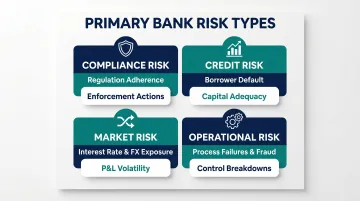
Technology can support each of these functions. But interpreting regulatory guidance, escalating findings to the board, and designing controls that hold up under examination — those still require experienced human judgment.
Governing Bodies and Key Frameworks
The four primary U.S. regulators — OCC, FDIC, Federal Reserve, and CFPB — each impose distinct compliance obligations depending on charter type and asset size. The CFPB, for instance, supervises institutions with over $10 billion in assets for federal consumer financial law compliance.
Key frameworks shaping staffing obligations include:
- Bank Secrecy Act (BSA) — requires a designated, independent BSA Officer with sufficient resources
- Dodd-Frank Act — mandates enhanced risk governance and stress testing capabilities
- Basel III — drives demand for risk measurement and reporting expertise
- GLBA, CRA, CFPB consumer rules — require trained compliance staff across consumer protection areas
These frameworks don't just shape policy — they drive specific hiring decisions. A BSA Officer role carries different credentials, reporting lines, and independence requirements than a CFPB consumer compliance hire. Treating them as interchangeable is exactly the kind of gap examiners flag.
Why Hiring the Right Compliance and Risk Talent Matters
The Real Cost of Getting It Wrong
TD Bank's $3 billion penalty wasn't just the result of bad processes — it was explicitly the result of inadequate compliance staffing. FinCEN found that TD Bank's AML program "languished" under a "flat cost paradigm" that prioritized cost-cutting over adequate resources. The bank allowed trillions of dollars in transactions to go unmonitored annually, in part because it added no new monitoring scenarios over eight years.
The personal liability dimension carries its own weight. In 2020, FinCEN fined Michael LaFontaine — then Chief Operational Risk Officer at U.S. Bank — $450,000 personally for failing to ensure the BSA function had enough staff to review transaction alerts. The bank had improperly capped alert volumes and failed to act on repeated warnings.
Both cases point to the same conclusion: staffing decisions are enforcement decisions. That reality shapes what's at stake in every compliance hire.
The Talent Supply Constraint
The BLS reports 418,000 compliance officer positions in the U.S. as of 2024, with projected growth of just 3% through 2034. Regulatory complexity is expanding far faster than that. The result: a competitive market where experienced professionals — particularly those with BSA/AML expertise, RegTech fluency, or prior regulatory agency experience — receive multiple offers quickly.
For banks, this has two practical implications:
- Hiring timelines stretch when searches aren't structured for this market
- Understaffed teams don't just create operational gaps — they create heightened examination exposure, as regulators consistently flag compliance function adequacy during exams
The Shift to Proactive Compliance
Modern compliance programs require professionals who can anticipate regulatory changes, not just react to examination findings. That means hiring for candidates who can:
- Monitor FinCEN guidance updates and CFPB rulemaking in real time
- Translate regulatory shifts into program changes before an examiner flags them
- Maintain, validate, and evolve automated monitoring systems
- Recognize when existing monitoring scenarios are outdated — and act on it
This last point connects directly to RegTech. Technology now accounts for roughly 40% of total compliance costs at financial institutions. Candidates who only work within static, manual frameworks are increasingly mismatched for these roles. TD Bank's enforcement action made the stakes concrete: failure to update transaction monitoring scenarios over eight years was cited as a direct contributor to its BSA failures.
Key Roles to Hire for in Bank Compliance and Risk Management
CCO and CRO: Strategic Leadership
The Chief Compliance Officer owns the compliance program — policy, training, monitoring, testing, and regulatory relationships. The Chief Risk Officer takes a broader view, overseeing enterprise risk across credit, market, operational, and compliance dimensions. Smaller banks often combine these functions; larger institutions need both.
Federal Reserve SR 08-8 makes the governance expectations explicit: the board must oversee the compliance strategy, hold senior management accountable, and ensure compliance officers have "appropriate authority, independence, and access to personnel and information." Board-level reporting is a regulatory expectation, not a discretionary practice.
BSA/AML Officer and AML Analysts
BSA/AML compliance is among the highest-scrutiny areas for U.S. regulators, and the BSA Officer role carries specific independence requirements. The OCC Comptroller's Handbook requires this officer to be "organizationally separated" from business lines and given sufficient resources to execute their duties — including adequate analyst staffing to review monitoring alerts.
The TD Bank and U.S. Bank cases both illustrate what happens when those requirements aren't met. Banks should treat BSA Officer independence and AML team headcount as fixed structural requirements, not budget variables.
Compliance Managers and Regulatory Affairs Specialists
These roles manage the day-to-day program across several areas:
- Policy development and monitoring calendars
- Testing schedules and control documentation
- Tracking regulatory changes under HMDA, TILA, ECOA, and UDAAP
Regulatory Affairs Specialists in particular need to monitor agency rulemaking actively and translate changes into program updates before they surface as examination issues.
Risk Management Analysts
Risk analyst hiring requires matching technical background to the specific risk type:
- Credit Risk — financial modeling, loan portfolio analytics, reserve methodology
- Operational Risk — process assessment, control design, loss event analysis
- Market Risk — quantitative skills, interest rate sensitivity, VaR modeling
These aren't interchangeable roles. A strong credit analyst won't necessarily have the quantitative background for market risk work, and vice versa.
Across Wayoh's 10+ years placing professionals in community, commercial, and investment banks, the firm recruits across all of these functions — from analyst-level AML investigators to senior risk leadership — with the same human-first, network-first approach adapted to the specific seniority and technical requirements of each search.
Essential Skills and Qualifications to Look For
Regulatory Knowledge Depth
Candidates should demonstrate working familiarity with the specific laws governing the bank's charter and business lines — not just generic awareness. During screening, ask candidates to walk through how they've handled a specific regulatory change or exam finding. Vague answers signal surface-level knowledge; specific process descriptions signal real experience.
Key Certifications by Role
| Certification | Issuing Body | Role Relevance | Priority |
|---|---|---|---|
| CAMS | ACAMS | BSA/AML Officers, AML Analysts | Near-essential |
| CRCM | ABA | CCOs, Compliance Managers | Near-essential |
| FRM | GARP | CROs, Risk Managers | Strongly preferred |
| PRM | PRMIA | Risk Managers | Preferred |
| CISA | ISACA | IT Compliance, Cybersecurity Risk | Preferred |
| CFE | ACFE | Fraud Risk, AML Investigation | Preferred |
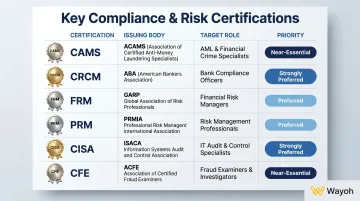
CAMS and CRCM function as credentialing floors for their respective roles — their absence requires a strong explanation. FRM, CISA, and CFE strengthen specialized candidacies but aren't disqualifying on their own.
Technology and Data Fluency
Credentials matter, but practical tools knowledge is what makes a candidate operational from day one. Look for hands-on experience with transaction monitoring systems, compliance management platforms, and data reporting tools. For AML, KYC, and regulatory reporting roles, RegTech fluency is core to the job function — not supplemental.
Independence and Communication
Federal Reserve SR 08-8 requires compliance staff to be independent of the business lines they oversee. Beyond structural independence, strong candidates demonstrate the judgment to escalate issues without being prompted, and the communication skills to present compliance findings clearly to senior leadership and boards. These traits rarely appear on a resume. Surface them in interviews by asking for specific behavioral examples of when a candidate pushed back on a business line or escalated a finding proactively.
Regulatory Agency vs. Institutional Background
Former OCC, FDIC, and CFPB examiners bring a regulator's lens: they know how examiners think, what triggers findings, and how examination reports are constructed. Former bank professionals bring program management depth and practical knowledge of how compliance operates inside a large institution. Neither background is universally superior — the right choice depends on whether the bank needs examination preparedness or ongoing program execution.
Best Practices for Hiring Compliance and Risk Professionals
Temporary vs. Permanent Staffing
Interim and contract placements make sense when:
- Responding to a consent order or regulatory remediation project
- Preparing for an upcoming safety and soundness or BSA examination
- Covering a sudden team gap while a permanent search runs in parallel
- Launching a new compliance program that needs immediate resources
Permanent placement is the only responsible approach for:
- BSA/AML Officer and ongoing AML program oversight
- CCO and senior risk leadership roles
- Any position with board-facing reporting responsibilities or fiduciary obligations
Continuity matters in regulated functions. Regulators evaluate whether compliance staffing is stable and adequately resourced — high turnover in senior roles is itself an examination flag.
That stability concern shapes how Wayoh approaches both models. Interim placements are fully vetted with references and background checks before placement, and the firm offers transparent conversion terms from day one for banks that want to evaluate a consultant before committing to a permanent hire.
Working with a Specialized Financial Services Recruiter
A generalist agency can fill a seat. A specialized recruiter can evaluate whether a candidate's regulatory knowledge actually matches the bank's charter type, risk profile, and examination history.
The practical differences matter in this space:
- Assesses credential relevance directly — CAMS vs. CRCM, BSA program design experience, regulatory agency background
- Reaches passive candidates not browsing job boards, particularly for senior BSA/AML and risk leadership roles
- Conducts CCO searches discreetly, without signaling instability to the market
Wayoh has placed compliance and risk professionals across major U.S. markets — including New York and California — for over 3 years. Every search starts with a structured intake conversation covering regulatory priorities, reporting structures, and role-specific requirements. Candidates are screened through real conversations and reference-checked before presentation, not matched by keyword.
Frequently Asked Questions
What is risk management and compliance in banking?
Compliance risk management focuses on adherence to specific laws and regulations — BSA, Dodd-Frank, CFPB rules — and the processes that prevent violations. Broader risk management covers credit, market, and operational exposures. Both functions protect a bank's financial stability and regulatory standing, though they're typically staffed by distinct teams with different technical backgrounds.
How do banks manage compliance risk?
Banks identify applicable regulations, perform risk assessments, implement internal controls, and run ongoing monitoring and testing cycles. Policies are updated as regulations change. RegTech tools support this process, but dedicated compliance professionals remain essential to design, oversee, and evolve the program.
What is the $3,000 rule in banking?
The $3,000 rule stems from the Bank Secrecy Act (31 CFR 1010.415) and requires banks to verify and record the identity of customers purchasing monetary instruments — such as money orders or cashier's checks — using cash between $3,000 and $10,000. It's a distinct recordkeeping requirement from the $10,000 Currency Transaction Report threshold and is a core BSA/AML officer responsibility.
What qualifications should a bank compliance officer have?
Relevant degrees include finance, law, or business administration. Key certifications are CRCM for compliance management roles and CAMS for AML-focused positions; a JD is valuable for regulatory affairs work. Candidates should also demonstrate familiarity with the regulators and frameworks governing the bank's charter type and business lines.
What is the difference between risk management and compliance in banking?
Compliance focuses on adherence to specific laws and regulations; risk management takes a broader view of potential threats — financial, operational, and reputational. The two functions overlap considerably, but they're typically led by different professionals. A CCO manages the compliance program; a CRO oversees enterprise-wide risk. Larger banks need both; smaller institutions sometimes consolidate them under one leader.