
Global AML fines totaled $4.6 billion in 2024, with transaction monitoring failures alone accounting for $3.3 billion of that total. TD Bank's $3.09 billion penalty — the result of processing over $3 trillion in transactions with inadequate monitoring — made the cost of understaffed analytics functions impossible to ignore.
For compliance leaders, talent acquisition heads, and HR teams at banks and fintechs, the pressure is real. Examiners expect analytics-driven AML programs. The candidate pool for people who can actually build and run them is genuinely thin.
This article covers what AML analytics actually is, which roles are in demand, what the skill stack looks like, and why this market is harder to navigate than most compliance hiring.
Key Takeaways
- AML analytics sits at the intersection of financial crime compliance and data science — generalist compliance hires rarely qualify
- Banks prioritize regulatory depth and platform familiarity; fintechs need builders who can stand up programs from scratch
- Strong candidates combine transaction monitoring experience, SQL or Python proficiency, and working knowledge of BSA/FinCEN/FATF frameworks
- Dual compliance-plus-data expertise takes years to develop, and consulting firms, RegTech vendors, and fintechs all compete for the same narrow pool
- A specialized recruiter with an active network in regulated financial services cuts time-to-fill while maintaining candidate quality
What Is AML Analytics?
AML analytics is the application of data-driven methods — transaction monitoring, statistical modeling, network analysis, and machine learning — to detect, investigate, and report suspicious financial activity. It is distinct from general compliance work in that it is quantitative, systems-oriented, and dependent on technical tooling.
Traditional rules-based systems flag transactions using static thresholds, producing false positive rates between 85% and 95%. Only 1% to 5% of alerts result in SAR filings. At a large institution processing 10,000+ alerts daily, that false positive burden translates to hundreds of analyst hours wasted every day.
Modern AML programs layer machine learning models, graph analytics, and dynamic risk scoring on top of legacy rules to reduce noise and improve detection. The people who configure, validate, and interpret these systems are the talent in focus here.
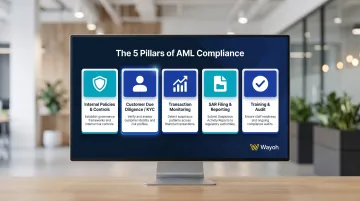
The Five Pillars — and Where Analytics Fits
AML programs are typically organized around five pillars. Analytics professionals operate across all of them:
- Internal policies and controls — governance and program design
- Customer due diligence (KYC/CDD) — identity verification and risk classification
- Transaction monitoring — alert generation, investigation, and tuning
- SAR filing and reporting — documenting and reporting suspicious activity
- Training and independent audit — staff competency and program testing
Analytics talent touches every pillar, but the heaviest concentration falls in transaction monitoring, CDD, and audit readiness — the three areas where reducing false positives and improving detection accuracy have the most direct cost impact.
The AML Analytics Roles Banks and Fintechs Are Actively Hiring For
"AML analytics" is not a single job title. It spans a spectrum of roles with meaningfully different skill requirements, and lack of clarity here is one of the most common sources of mis-hires. Before starting a search, hiring managers need to be specific about which function they are actually filling.
AML/BSA Transaction Monitoring Analyst
The most common entry-to-mid-level hire. Core responsibilities include:
- Reviewing alerts from transaction monitoring systems
- Investigating flagged activity and documenting conclusions
- Filing SARs when activity meets reporting thresholds
- Tuning alert parameters to reduce false positives
- Identifying patterns across large case volumes
Platforms to screen for: NICE Actimize, Fiserv AML Manager, Oracle FCCM, SAS AML. The specific platform matters less than demonstrated ability to configure and operate them.
Increasingly, institutions want these analysts to have SQL skills — so they can pull their own ad hoc data sets rather than waiting on technology teams for every query.
AML Model Risk / Quantitative Analyst
A more technical, typically senior profile. Responsible for building, validating, and back-testing the statistical or machine learning models that power transaction monitoring and risk scoring.
These candidates usually hold backgrounds in statistics, econometrics, or applied data science. They must also understand model risk management guidance — the OCC/Fed framework originally established as SR 11-7, updated in April 2026 — alongside AML-specific regulations.
This is the hardest profile to source. Credit risk, fraud, and market risk functions all compete for the same quantitative skill set, and large banks, fintechs, and consulting firms are bidding against each other for a genuinely short candidate pool.
AML Compliance Technology / Systems Analyst
A hybrid role: part compliance analyst, part system administrator. Responsibilities typically include:
- Configuring and maintaining AML platforms, scenario libraries, and data feeds
- Testing system outputs against examination standards
- Coordinating between compliance, IT, and vendor teams
- Supporting platform migrations or new implementations
Common at fintechs building AML infrastructure from scratch and at banks undergoing system modernization. Filling it well means finding someone who can hold a technical conversation with engineers in the morning and satisfy an examiner's questions in the afternoon — two skill sets that rarely appear on the same résumé.
The Skill Stack That Defines Strong AML Analytics Talent
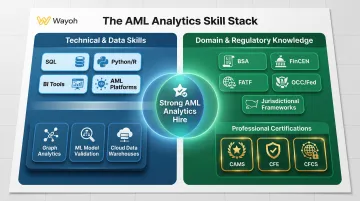
Many AML analytics candidates look strong on paper but lack one of the two core domains — either the regulatory depth or the technical proficiency. Screening for both requires a structured approach.
Technical and Data Skills
Core skills to screen for at most levels:
- SQL — essential for querying transaction data and pulling investigative data sets
- Python or R — increasingly relevant for model-adjacent and senior analytics roles
- BI tools — Tableau or Power BI for reporting and operational dashboards
- AML platform experience — Actimize, Fiserv, Oracle FCCM, or SAS AML
Skills that signal a more senior or specialist profile:
- Graph analytics and entity resolution for uncovering layered financial crime structures
- Machine learning model validation under SR 11-7 / OCC 2026-13 framework
- Experience with cloud data warehouses or data lakes at scale
These advanced capabilities are differentiators, not baseline requirements. Require them for senior hires; treat them as a development trajectory when the role has runway to grow into them.
Domain and Regulatory Knowledge
The compliance knowledge baseline for most AML analytics roles:
- BSA — reporting requirements, SAR thresholds, CTR filing obligations
- FinCEN guidance — including the 2018 joint agency statement encouraging AI/ML adoption and the 2020 Anti-Money Laundering Act
- FATF recommendations — particularly for institutions with international exposure
- OCC/Fed examination expectations — for larger bank programs
- Jurisdictional frameworks — FINTRAC (Canada), FCA (UK), or others for internationally operating fintechs
Certifications serve as a useful proxy for foundational knowledge. CAMS (Certified Anti-Money Laundering Specialist) from ACAMS is the industry standard. CFE (Certified Fraud Examiner) and CFCS (Certified Financial Crime Specialist) add relevant coverage, particularly for roles spanning AML and fraud. They confirm foundational knowledge and professional commitment, but hands-on performance still needs to be validated through the interview process.
Investigative and Communication Skills
Two underweighted capabilities that frequently differentiate strong hires:
- Written communication: AML analysts write SAR narratives for regulators and summarize findings for legal and compliance leadership. Weak writing is a common failure point even for technically strong candidates — ask to see a writing sample or sanitized SAR narrative during screening.
- Cross-functional collaboration: These roles require ongoing coordination with IT, legal, operations, and external examiners. Candidates from siloed environments often struggle once they need to work across departments. Probe for specific cross-functional examples during interviews.
Why Sourcing AML Analytics Talent Is Harder Than Most Roles
Finding strong AML analytics talent means finding one person who carries two distinct skill sets — compliance domain expertise and data proficiency — that typically develop in separate career paths. Most financial crime professionals come from either a banking/legal background or a data/tech background. Rarely both.
The BLS reports 418,000 compliance officer positions in 2024 with projected growth of only 3% through 2034. That modest supply growth is happening against a backdrop of rising regulatory complexity, expanding fintech enforcement, and a technology transition that demands an entirely different skill set than the workforce was trained on.
The Competition Has Expanded
Banks are no longer competing only with each other. The candidate pool for strong AML analytics professionals is targeted by:
- Deloitte, PwC, and Accenture recruit directly from financial crime compliance functions, offering higher compensation and broader career variety
- RegTech vendors building AML platforms need professionals who understand both compliance requirements and technical implementation
- Fintechs building programs from scratch offer equity and flexibility that traditional banks typically cannot match
This competitive pressure has driven up compensation expectations and lengthened hiring cycles — and when a search stalls, the operational consequences are immediate.
The Cost of a Vacancy or a Wrong Hire
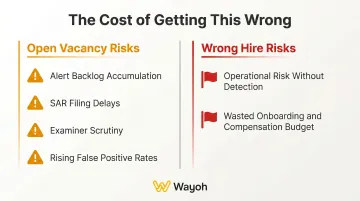
An open AML analytics role carries real regulatory exposure:
- Transaction monitoring alert backlogs accumulate
- SAR filing timelines slip past 30-day requirements
- Examiners notice understaffed compliance functions during reviews
- False positive rates creep up without someone actively tuning thresholds
A mis-hire — someone who looks right on paper but lacks one of the two core competency domains — can create equal or worse operational risk while consuming onboarding time and compensation budget.
What a Specialized Recruiter Brings to This Search
Wayoh's human-first approach to compliance, risk, and legal hiring in regulated financial services means access to a vetted network of AML analytics professionals — including passive candidates who are not responding to job postings. With over 500 placements across banking and fintech, the firm shortens search cycles by qualifying candidates on both technical fit and regulatory depth before the first submission, instead of passing that assessment to the client's interview process.
The network-first approach is particularly valuable for dual-competency roles. Professionals who hold both SQL fluency and CAMS-level regulatory knowledge are typically placed through direct outreach — not discovered through job boards.
Banks vs. Fintechs: How AML Analytics Hiring Needs Differ
The institution type shapes the profile significantly. Getting this wrong early in a search wastes time on both sides.
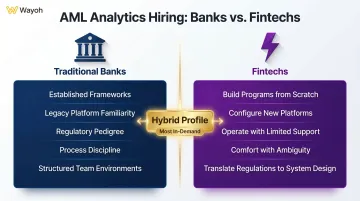
What Traditional Banks Typically Need
- Candidates who can operate within established compliance frameworks and meet examiner expectations
- Familiarity with legacy platform environments (often Actimize or SAS at scale)
- Regulatory pedigree: prior experience at similarly regulated institutions, CAMS credential, demonstrated exam-readiness
- Process discipline: documentation standards, workflow adherence, audit trail management
- Comfort operating within larger teams with defined roles and governance structures
What Fintechs Typically Need
Fintechs — especially those scaling through money transmitter licenses or pursuing bank charter applications — often need a different profile entirely:
- Build AML programs from scratch, not just operate within existing ones
- Configure new platforms, define scenario libraries, and design data feeds without an established tech stack
- Make sound compliance decisions without a large support team or escalation path
- Operate comfortably with ambiguity, rapid change, and cross-functional ownership
- Translate regulatory requirements directly into system design decisions
Enforcement actions against Robinhood ($45 million SEC fine), Starling Bank (FCA Final Notice), and Klarna ($45 million) confirm that fintechs face the same BSA/AML examination expectations as traditional banks — but often without the institutional infrastructure to support them.
The Hybrid Profile Is Increasingly In Demand
That regulatory pressure is exactly what's driving demand for candidates who can do both. As large banks modernize legacy AML infrastructure and fintechs mature into more structured compliance environments, the most competitive candidates combine regulatory knowledge with technical fluency. When scoping a search, the practical question is whether you need someone to operate within a program or build one — and that distinction changes everything about the brief.
Frequently Asked Questions
What is anti-money laundering analytics?
AML analytics uses data techniques — transaction monitoring, statistical modeling, network analysis, and machine learning — to identify and report suspicious financial activity at scale. It enables institutions to process high transaction volumes while reducing the false positive burden that slows manual compliance review.
What are the 5 pillars of anti-money laundering?
The five pillars are: internal policies and controls, customer due diligence (KYC/CDD), transaction monitoring, SAR filing and reporting, and training and independent audit. Analytics talent directly supports at least three of these — transaction monitoring, CDD risk scoring, and audit readiness documentation.
What skills should an AML analytics professional have?
Core skills include SQL for data querying, Python or R for model-adjacent roles, experience with platforms like Actimize or Oracle FCCM, and working knowledge of BSA/FinCEN/FATF frameworks. Strong written communication for SAR narratives is frequently underweighted but operationally critical. CAMS certification signals foundational regulatory competence.
Why is AML analytics talent so hard to find?
The dual requirement — compliance domain expertise plus data and technical proficiency — creates a genuinely narrow candidate pool. Most professionals have depth in one area, not both. That constraint is compounded by active competition from banks, fintechs, consulting firms, and RegTech vendors pursuing the same candidates, driving up compensation expectations and lengthening search timelines.
How is AML analytics hiring different for fintechs vs. traditional banks?
Banks typically need candidates with regulatory pedigree and familiarity with established compliance frameworks and existing platform environments. Fintechs often need versatile builders who can stand up programs from scratch with limited team support. Either way, the institution's compliance maturity stage and near-term regulatory obligations should shape the hiring brief.
What certifications matter most when hiring AML analytics talent?
CAMS (Certified Anti-Money Laundering Specialist) is the industry standard and the credential most recognized by bank examiners. CFE (Certified Fraud Examiner) and CFCS (Certified Financial Crime Specialist) add value in roles that span AML and broader financial crime. Treat certifications as a baseline signal — hands-on experience with data tools and monitoring systems is what separates strong candidates from qualified ones.