What's making 2026 a genuine inflection point? Four forces are converging simultaneously: the strategic elevation of the CCO mandate, the emergence of AI governance as a non-negotiable skill, an unprecedented surge in CCO demand from fintech and crypto, and growing candidate scrutiny of reporting structures. Together, they're creating a hiring environment where the old playbook simply doesn't work.
Whether you're a financial services firm looking to fill a CCO seat or a compliance professional weighing your next move, understanding these trends isn't optional — it's how you compete.
Key Takeaways
- CCO job descriptions now emphasize strategic leadership, board presence, and AI governance alongside traditional regulatory expertise
- Demand is accelerating across fintech, crypto, and BNPL as regulatory pressure formalizes compliance programs
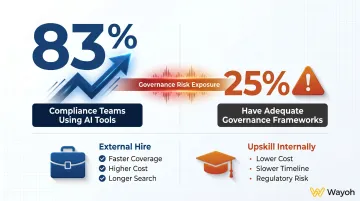
- 83% of compliance teams use AI tools, yet only ~25% have adequate governance frameworks — CCOs who can close that gap command a significant talent premium
- Reporting structure (CEO vs. GC) is increasingly a deal-breaker for experienced candidates
- Financial services leads all sectors in CCO pay, with JD holders earning significantly higher total compensation
Trend 1: The Strategic Elevation of the CCO Role
Financial services CCOs are no longer focused exclusively on regulatory programs. They're now expected at the board table — participating in M&A diligence, new product approvals, capital allocation discussions, and enterprise risk strategy.
Russell Reynolds Associates analysis confirms this shift, describing the CCO as having evolved "from a policy custodian into a governance leader, involved in strategy, oversight, and the orchestration of systems." This represents a structural redefinition of the role, not incremental change.
How This Shows Up in Hiring
At banks and fintechs, CCO job briefs increasingly include language like "executive presence," "cross-functional influence," and "strategic partner to the C-suite." These aren't soft descriptors. They reflect a real expectation that the CCO can operate as a peer to the CFO and General Counsel, not a subordinate.
Regulatory enforcement is accelerating this trend. In January 2025, the SEC charged 12 firms — including Blackstone Alternative Credit Advisors — for recordkeeping failures, resulting in over $63 million in combined penalties. In separate July 2025 actions, two individual CCOs faced personal fines and multi-year industry bars for falsifying and backdating compliance records. Regulators are now holding individual executives accountable — not just the institutions they oversee.
The JD Premium and Talent Shortage
Firms have responded by paying significantly more for CCOs who combine legal credentials with executive leadership experience. BarkerGilmore's 2025 CCO Compensation Report found:
- Compliance officers from Top 50 law schools earn 55% more than those from schools ranked 100+
- Those with Am Top 50 law firm experience earn 85% more in total compensation
- Financial services is the highest-paying sector for CCO roles overall
- The average CCO search takes approximately 105 days

A 105-day average search reflects a genuine supply problem. The pool of professionals who combine deep regulatory expertise with C-suite leadership credibility is narrow, and searches stall when firms underestimate that — or when the role brief undersells the strategic scope candidates expect.
Trend 2: AI Proficiency as a Core CCO Hiring Criterion
For a CCO in 2026, AI proficiency means governing, auditing, and owning compliance accountability for AI systems that make credit decisions, flag suspicious transactions, or underwrite loans — not just reviewing their outputs.
Financial services firms deploying AI in AML/KYC screening, algorithmic trading, and fraud detection now need CCOs who can answer to regulators about those systems — not just sign off on the outputs.
The Governance Gap Is Real
A 2026 Compliance Week survey found that more than 83% of compliance teams now use AI tools, but only approximately 25% have implemented a strong governance framework. That gap is a direct liability — and it lands squarely on the CCO.
The CFPB has issued guidance requiring lenders using AI for credit decisions to provide specific, accurate reasons in adverse action notices — model complexity is not an acceptable explanation for vague denials. The OCC's SR 11-7 guidance extends model risk management requirements to AI and machine learning systems. And for firms with EU operations, the EU AI Act mandates that high-risk AI systems — including credit scoring, fraud detection, and AI underwriting — meet full compliance requirements by August 2, 2026, with penalties reaching EUR 35 million or 7% of global turnover.
What This Means for Hiring
CCO candidates with AI governance experience are genuinely scarce. Firms are confronting a choice between two strategies:
- Hire externally for a CCO with demonstrated RegTech and AI oversight experience — faster compliance coverage, higher cost, longer search
- Upskill internally — lower cost, slower, and risky if regulatory pressure is immediate
Both carry trade-offs. Firms that defer the decision entirely take on the most exposure — facing regulatory scrutiny without adequate compliance leadership in place while a search stretches on for months.
Trend 3: The Fintech and Crypto CCO Talent Surge
A significant wave of fintech companies — crypto exchanges, BNPL providers, embedded finance platforms, and digital banking startups — that operated for years without formal compliance leadership are now urgently hiring CCOs.
The catalysts are direct. The DOJ's indictment of FTX founder Samuel Bankman-Fried in December 2022 (he was convicted on all counts in November 2023) exposed the near-total absence of compliance infrastructure at one of the world's largest crypto exchanges. Post-FTX, regulators and investors stopped treating compliance leadership as optional for crypto and fintech firms. The SEC has since pursued enforcement actions against Silvergate and Galois Capital, among others.
The urgency is well-founded. Compliance failures consistently rank among the leading causes of fintech shutdowns — through regulatory penalties, license revocations, or loss of banking partnerships that make operations impossible.
The Competition Problem for Traditional Banks
Fintech and crypto firms are pulling experienced compliance talent from conventional financial institutions by offering:
- Equity compensation that traditional banks can't match
- Broader mandate — building a compliance function from scratch versus maintaining an established one
- Faster career trajectory in a higher-growth environment
This is creating direct competitive pressure for regional banks and mid-market institutions. When a Series B fintech offers equity upside and the chance to build something, structured corporate roles become a harder sell.
First-Time CCO Hires: A Different Search
Fintech firms making their first CCO hire face a fundamentally different challenge than banks replacing an existing executive. They need someone who can build from nothing: policy infrastructure, compliance culture, regulatory relationships, and team structure — often with no internal support to lean on.
That means the search criteria shift entirely. Wayoh approaches these engagements by distinguishing between two candidate profiles:
- Builders — executives who establish compliance frameworks in fast-moving, resource-constrained environments
- Operators — executives who run and optimize compliance programs that already exist
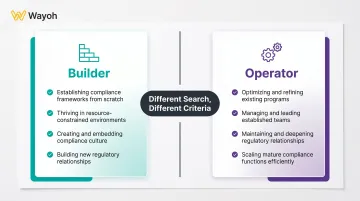
A candidate who excels in one context often struggles in the other. Getting that distinction right is what separates a successful first CCO hire from a costly misfire.
Trend 4: Shifting Expectations Around CCO Reporting Lines
A growing number of experienced CCO candidates are treating reporting structure as a filter — not a preference, but a deciding factor in whether to engage with an opportunity.
The data explains why this has become a friction point. BarkerGilmore research shows 58% of CCOs report to the General Counsel, while only 22% report directly to the CEO. Yet OCC guidance specifically emphasizes that compliance officers should have "the authority and independence to facilitate compliance throughout the bank." That structural gap isn't just a governance issue — it's something candidates notice.
The Deal-Breaker Dynamic
Senior CCO candidates have learned to read organizational structures carefully. A CCO title that sits under the General Counsel often signals:
- Limited authority to escalate issues independently
- Reduced access to the board
- A compliance function treated as a legal support function rather than a strategic one
- Vulnerability to budget cuts and scope reductions
Those signals become even sharper at mid-market firms under cost pressure, where there's a visible trend toward role downgrading — replacing CCO titles with Compliance Director positions under the GC to cut compensation costs. Experienced candidates recognize this pattern immediately. It signals cultural misalignment and is a reliable predictor of search failure.
For hiring firms, the implication is straightforward: clarify reporting lines and the scope of organizational authority before the search begins. When that independence is unclear, top candidates disengage early — and searches either stall or close with the wrong hire.
What's Driving These CCO Hiring Trends
Three pressures — regulatory expansion, a RegTech-driven shift in the CCO's role, and a thin talent market — are reshaping what firms need from CCO candidates and how difficult it is to find them.
Regulatory Complexity and Personal Liability
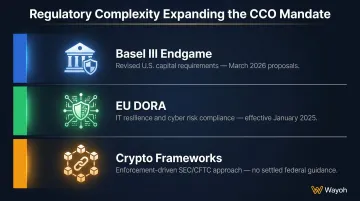
The volume of new regulation affecting U.S. financial services is expanding the CCO mandate on multiple fronts:
- Basel III Endgame — U.S. banking agencies issued revised proposals in March 2026, reshaping capital requirements and creating new compliance obligations for treasury, risk, and data teams
- EU DORA — Effective January 2025, applies to U.S. firms with EU customers or third-party providers, expanding IT resilience and cyber risk compliance requirements
- Crypto frameworks — No comprehensive federal framework exists; enforcement-driven approaches from the SEC and CFTC require CCOs who can operate without settled regulatory guidance
Personal liability is making candidates far more selective. Recent enforcement examples illustrate the stakes:
- The SEC imposed a $40,000 fine and three-year industry bar on a CCO in July 2025 for falsifying compliance records
- A 2022 action against a Hamilton Investment Counsel CCO resulted in a five-year bar for failing to address an employee's unreported activities
Candidates now demand clear authority, indemnification coverage, and demonstrated organizational support before accepting offers.
Technology Acceleration and the RegTech Boom
Juniper Research projects global RegTech spending will reach $207 billion by 2028, a 124% increase from 2023. More recent estimates put the market at $245 billion, with financial institutions expecting $2.37 billion in 2026 RegTech spend alone.
AI and automation are simultaneously reducing compliance headcount and raising expectations on the CCO. Fewer analysts handle routine monitoring; more judgment is required at the top of the function.
Talent Supply and Demand Imbalance
- 43% of global banks report critical regulatory work going undone due to staffing gaps (Deloitte 2025)
- 72% of CCOs say staffing shortages directly contributed to regulatory findings (Thomson Reuters 2025)
- Average vacancy duration for senior compliance roles has reportedly reached 18 months
With vacancy windows stretching this long, firms that rely on open job postings are starting searches at a structural disadvantage. Wayoh's human-first CCO and senior compliance searches run through direct relationship networks built over 10+ years in banking and fintech — which means access to qualified candidates who aren't actively applying.
Competitive Dynamics: Fintech vs. Traditional Banks
Fintech and crypto firms are bidding up compensation and pulling experienced candidates from traditional institutions. Traditional banks that move slowly — or can't articulate what the CCO role actually owns — consistently lose candidates to faster-moving competitors.
How These Trends Are Reshaping CCO Hiring — and What Lies Ahead
Operational and Compensation Impact
CCO searches are taking longer and requiring more stakeholder alignment upfront. Harvard Business Review data puts the cost of a failed executive hire at 2.5x to 15x annual salary , a significant exposure for any firm that treats CCO selection as a routine hire.
On compensation, the BarkerGilmore 2025 data shows a nuance worth understanding:
- Median salary increases slowed to 2.7% in 2025, down from 5.1% in 2024
- Average bonus: $125,551 against a target of $134,391 (88% payout)
- 56% of current CCOs are considering a job change in the coming year
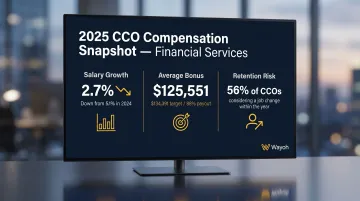
That last statistic reflects a retention problem, not just a hiring one. Firms that consolidate the CCO role under legal to reduce costs often pay more when a high-profile compliance failure occurs, and potentially more again when replacing a departing CCO in a compressed market takes longer than expected.
These cost pressures point toward structural shifts already underway. Here's what the next one to three years looks like.
Future Signals to Watch (1–3 Years)
Fractional and interim CCO models are growing in adoption, particularly among fintechs that need experienced compliance leadership immediately. Firms like Fraxtional offer dedicated interim CCO placement as an alternative to a full executive search. Wayoh supports similar engagements for firms managing leadership transitions, audit readiness, or rapid growth phases, providing interim coverage while a permanent search runs in parallel.
Hybrid AI/compliance roles are likely to emerge as AI-driven compliance tools become more capable. The distinction between "compliance professional who uses AI" and "AI governance specialist who understands compliance" will likely converge into a distinct role category.
ESG compliance will expand the CCO mandate further. California SB 253 requires large enterprises to report Scope 1 and 2 emissions by August 2026. The EU CSRD adds a "double materiality" standard for multinationals.
Federal climate disclosure rules may be suspended at the SEC level, but state and international obligations are filling the gap, creating a new compliance surface that CCOs at multinational financial institutions will increasingly own.
Conclusion
CCO hiring in financial services in 2026 is being reshaped by four forces operating simultaneously: the strategic elevation of the role, the demand for AI governance fluency, the fintech talent surge, and growing candidate expectations around reporting independence. These pressures don't operate in isolation — they reinforce each other, shrinking the qualified candidate pool while raising the stakes on every search.
Firms that treat the CCO search as a strategic leadership decision — defining scope, authority, and reporting structure before going to market — hire faster and more effectively than those running reactive searches. That preparation also means engaging recruiters with genuine networks in compliance and financial services, not just broad sourcing channels.
The four forces shaping this market:
- Strategic elevation: CCOs now report at board level and own cross-functional risk programs
- AI governance fluency: Technical literacy in model risk and algorithmic compliance is a baseline expectation
- Fintech talent surge: Demand from high-growth fintechs is pulling qualified candidates from traditional institutions
- Reporting independence: Candidates increasingly filter roles by structural authority, not just title
Wayoh has spent over 3 years building relationships with compliance leaders across banking, fintech, and regulated industries — with 500+ placements in roles exactly like this one. In a market where the right CCO candidate may not be actively looking, that network matters. Firms ready to start a search can reach out at hiring@wayoh.com.
Frequently Asked Questions
How much does a Chief Compliance Officer make in the US?
According to BarkerGilmore's 2025 CCO Compensation Report, average bonuses in financial services reached $125,551 — the highest-paying sector across industries. CCOs with JD degrees from Top 50 law schools earn up to 55% more than peers without comparable credentials.
Are Chief Compliance Officers in demand?
Yes — demand is strong and growing, particularly across fintech, crypto, and traditional banking. Deloitte's 2025 data shows 43% of global banks have regulatory work going undone due to staffing gaps, and senior compliance vacancy durations have reached 18 months in some markets. The expanded strategic mandate of the CCO role is widening the supply-demand gap further.
Will Chief Compliance Officers be replaced by AI?
AI handles monitoring, pattern detection, and reporting at scale, but regulatory interpretation, board communication, and ethical judgment cannot be automated. AI has actually raised the bar: CCOs now need to govern AI systems on top of traditional compliance duties, making technical fluency a hiring asset rather than a replacement threat.
What qualifications are financial services firms looking for in a CCO in 2026?
Firms are prioritizing financial regulatory expertise (AML, KYC, SEC/CFPB rules), a JD or equivalent advanced degree, demonstrated AI and RegTech literacy, and the executive presence to communicate effectively with boards and regulators. The combination of all four in one candidate is rare, which is why searches take as long as they do.
Why is hiring a CCO in financial services so difficult right now?
The candidate pool that combines deep regulatory knowledge, technology fluency, and proven C-suite leadership experience is narrow — and shrinking relative to demand. Competition from fintech and crypto firms, which offer equity and broader mandates, has intensified pressure on traditional banks and mid-market institutions that can't match those packages or offer equivalent scope.