Introduction: The Growing Demand for Enterprise GRC Talent in Financial Services
Regulatory pressure on financial institutions isn't easing. Leadership shifts at the CFPB and OCC, ongoing BSA/AML enforcement activity, and multi-agency oversight across the OCC, FinCEN, and state regulators have pushed governance, risk, and compliance hiring to a strategic priority for senior leadership.
The talent supply hasn't kept pace. According to ManpowerGroup's 2025 Talent Shortage Survey, 67% of financial services employers report difficulty finding skilled talent — and GRC roles sit at the sharpest end of that shortage.
If you're an HR leader or hiring manager at a bank, fintech, or healthtech firm, this guide breaks down which GRC roles matter most right now, what qualifications actually move the needle, and what a sharper hiring strategy looks like in practice.
Key Takeaways
- Enterprise GRC unifies governance, risk management, and compliance into one framework — required for any regulated financial institution.
- Key roles span CRO, CCO, BSA/AML managers, risk analysts, and internal auditors — all in short supply.
- Top GRC candidates bring regulatory knowledge, data fluency, and the ability to communicate risk clearly to leadership.
- Standard job boards and generalist recruiters consistently fall short for these searches.
- Specialized recruiters with active compliance networks cut time-to-fill and surface higher-quality candidates.
What Is Enterprise GRC in Financial Services?
Enterprise GRC — governance, risk, and compliance — is the integrated framework through which financial institutions set direction, manage threats, and meet regulatory obligations simultaneously. The term was formalized by OCEG, which defines GRC as "the capability that enables an organization to reliably achieve objectives, address uncertainty, and act with integrity."
In practice, the three pillars look like this for financial services firms:
| Pillar | What It Covers |
|---|---|
| Governance | Board oversight, policy-setting, accountability structures |
| Risk Management | Credit, market, operational, and compliance risk identification and mitigation |
| Compliance | Adherence to BSA/AML, Dodd-Frank, UDAAP, CRA, FCRA, and applicable state laws |
Financial institutions operate under a more layered regulatory structure than nearly any other industry. The Congressional Research Service describes the U.S. financial regulatory system as "fragmented, with multiple overlapping regulators and a dual state-federal regulatory" structure.
In practice, a mid-size bank may simultaneously answer to the OCC, FDIC, CFPB, FinCEN, and state regulators — each with distinct, sometimes conflicting expectations.
That regulatory overlap directly expands the range of specialized GRC roles institutions must fill. A compliance officer fluent in UDAAP enforcement, for instance, may have little working knowledge of FinCEN's SAR filing expectations — which is why GRC hiring in financial services demands domain-specific expertise, not just general risk management experience.
The GRC Roles Financial Services Firms Are Hiring For
Enterprise GRC is not one role. It's a layered team structure, and mapping that structure clearly before starting a search is the difference between a well-targeted hire and months of wasted outreach.
Chief Risk Officer (CRO) and Chief Compliance Officer (CCO)
These are the most competitive hires in the GRC market. Both roles require deep regulatory expertise — but they also demand board-level communication skills, the ability to influence without authority across business lines, and a track record managing regulatory examinations.
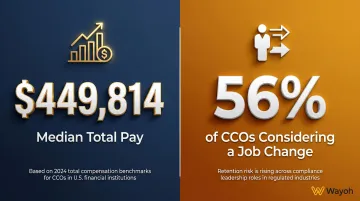
The compensation reflects the stakes. Glassdoor data puts median total pay for a Chief Compliance Officer in financial services at $449,814. Yet BarkerGilmore's 2025 CCO Compensation Report found that 56% of CCOs are considering a job change in the coming year, meaning retention risk is climbing even as salary growth cools.
Wayoh conducts executive searches for CRO and CCO roles across banking and fintech, with searches typically moving from briefing through offer acceptance in 8 to 16 weeks when the brief is clearly defined and decision-makers stay aligned.
Risk and Compliance Managers
Mid-level managers — BSA/AML Managers, Operational Risk Managers, Compliance Program Managers — are the operational backbone of any GRC function. They translate policy into procedure, manage exams and audits, and lead analyst teams.
These are also among the hardest roles to fill. The experience gap is real: you need someone who has run a BSA program or managed a regulatory exam cycle, not someone who has only observed the process. That profile is built through years of on-the-job exposure, and there's no shortcut.
Compliance Analysts and Risk Analysts
Entry-to-mid-level analyst roles focus on transaction monitoring, regulatory mapping, case management, and reporting. Demand for these positions is growing — and shifting. The BLS reports 418,000 compliance officer positions in the U.S. with 33,300 annual openings projected through 2034.
What's changing is the skills profile. Analysts who combine regulatory knowledge with data fluency — SQL, Excel modeling, GRC platform familiarity — are placed faster and at higher compensation. Job postings on Indeed for hybrid "Compliance Risk Data Analytics" roles now exceed 26,000, reflecting how far this shift has moved.
Internal Audit and Controls Professionals
Internal auditors sit at the intersection of risk assurance and compliance, validating that controls are actually working and not merely documented. Financial services audit roles require fluency in both regulatory frameworks and IT systems.
Candidates who combine those two domains are among the scarcest profiles in the entire GRC talent pool:
- Regulatory audit depth: Experience with Fed, OCC, or CFPB examination cycles
- IT/cyber fluency: Familiarity with SOX controls, cloud environments, or cybersecurity frameworks
- Cross-functional credibility: Ability to challenge both tech teams and business line leaders
Financial examiners are projected to grow at 19% through 2034, classified by the BLS as "much faster than average" — the steepest demand curve in GRC.
Emerging GRC Roles in Fintech and Healthtech
Fintech and healthtech firms are often building GRC functions from scratch, which creates a distinct hiring challenge. Roles like Data Privacy Officer, Third-Party Risk Manager, and Regulatory Affairs Manager require candidates who can:
- Operate with limited infrastructure and minimal precedent
- Build frameworks rather than inherit them
- Balance innovation pace against control requirements
- Navigate HIPAA, state privacy laws, or fintech charter obligations simultaneously
Wayoh sources for these roles across fintech and healthtech clients specifically, targeting candidates who combine technical regulatory knowledge with the operational agility to build programs from the ground up.
Skills and Certifications GRC Employers Demand
GRC hiring in financial services rarely comes down to a single qualification. The candidates who consistently move forward combine regulatory literacy, data fluency, and the communication skills to make complex requirements land with a skeptical CFO or a board audit committee.
Regulatory and Industry Knowledge
The baseline expectation for most financial services GRC roles includes working knowledge of:
- BSA/AML — transaction monitoring, SAR filing, customer due diligence
- Dodd-Frank — consumer protection, systemic risk requirements
- UDAAP, CRA, FCRA — fair lending and consumer finance obligations
- State-level regulations — which vary considerably by charter and geography
Candidates coming from insurance or healthtech are increasingly considered for transferable regulatory knowledge — particularly in risk management and privacy compliance functions.
Technical and Analytical Skills
Modern GRC roles have moved well beyond policy documentation. Employers now expect:
- Data analysis tools: Excel (advanced), SQL, Power BI
- GRC platforms: MetricStream, RSA Archer, ServiceNow GRC
- Regulatory reporting systems: Specific to charter type and regulator
Candidates who carry strong regulatory knowledge but lack data fluency face a growing disadvantage, especially at analyst and manager levels where automation is reshaping routine tasks.
GRC Certifications Employers Value
In practice, certifications reduce the hiring manager's due diligence burden — and they appear consistently in active GRC job briefs across banking and fintech:
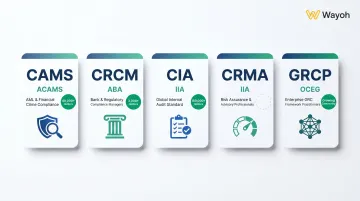
| Certification | Issuing Body | Notes |
|---|---|---|
| CAMS | ACAMS | 80,000+ holders; dominant in AML/financial crime roles |
| CRCM | ABA | Standard for bank regulatory compliance managers |
| CIA | IIA | 173,000+ holders globally; core for internal audit |
| CRMA | IIA | Paired with CIA for risk management assurance |
| GRCP | OCEG | Validates GRC framework knowledge broadly |
Soft Skills That Actually Differentiate Candidates
Two candidates can have identical regulatory knowledge and certifications. What separates them is often less tangible:
- Stakeholder influence — pushing back on business lines while keeping relationships intact
- Translation ability — converting regulatory requirements into terms that resonate with non-compliance executives
- Sound judgment under pressure — knowing when a control gap requires escalation versus when it warrants a pragmatic fix
For a CCO or CRO, these capabilities aren't supplementary — they define whether someone can actually operate at that level.
Why GRC Talent Is Hard to Find in Financial Services
The GRC talent market in financial services has three structural problems operating simultaneously: high demand, constrained supply, and fierce multi-directional competition.
A Shallow Pool with Deep Specialization Requirements
GRC expertise doesn't transfer cleanly from other industries. It's built through years of direct regulatory exposure — managing exams, interacting with examiners, navigating enforcement actions, and learning what regulators actually prioritize versus what the guidance says. That experience takes time, and there's no fast-track alternative.
The BLS median wage for compliance officers in finance and insurance is $79,920 — not a figure that draws in career changers from higher-paying fields. BSA/AML Officers average $90,567 annually according to ZipRecruiter, but experienced managers and directors command significantly more.
Competition from All Directions
Financial institutions aren't just competing with each other. According to BLS data, 37% of all U.S. compliance officers work in government — making federal and state agencies the single largest employer category in this occupation, larger than finance and insurance combined.
The revolving door is well-documented. Research from the New York Federal Reserve traces significant worker flows between regulatory agencies and the private sector. Regulatory employment offers stability, pension benefits, and mission appeal that compensation alone doesn't always offset. Private-sector hiring managers need to account for this when structuring offers.
The Real Cost of Getting It Wrong
A poor GRC hire — or an extended vacancy — isn't just an HR problem. It's a regulatory exposure.
The costs add up fast:
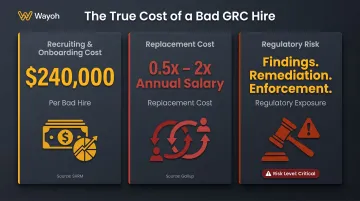
- SHRM estimates recruiting, hiring, and onboarding costs can reach $240,000 per hire
- Gallup puts replacement costs at 0.5x to 2x annual salary
- A compliance gap during a regulatory examination can trigger findings, remediation requirements, or enforcement action
Finding someone fast and finding someone qualified are rarely the same search — and in GRC, the margin for error on either is thin.
Why Generalist Recruiters Fall Short
Most general-purpose staffing firms lack the three things GRC searches actually require:
- Screening candidates on BSA exam history, MRA remediation, or third-party risk frameworks — without relying on the hiring manager to do it
- Reaching experienced GRC professionals at the manager and director level, who rarely respond to cold LinkedIn outreach and move through trusted relationships instead
- Knowing who in the market has actually run a compliance program versus who has sat adjacent to one
This is the gap that specialized financial services recruiters fill. Wayoh has spent over 3 years building direct relationships across GRC and compliance hiring in banking, fintech, and healthtech — guided by a human-first recruiting philosophy and sourcing from a pre-vetted network rather than running keyword searches against a cold database.
Building a GRC Hiring Strategy That Works
Define the Role Before You Post It
Vague job descriptions do real damage in GRC hiring. Experienced candidates read them as a signal that the organization hasn't thought through what it actually needs — and they move on.
Before writing a job description, map:
- The specific regulatory environment — charter type, primary regulators, recent exam history
- The team structure — who this person reports to and who reports to them
- The GRC platform stack — what systems they'll be expected to use from day one
- The program maturity — are they maintaining an existing program or building from scratch?
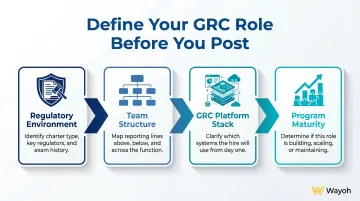
A clearly scoped brief shortens search timelines and improves candidate quality.
Use Specialized Channels and Networks
Effective GRC sourcing requires targeted channels, not broad posting:
- Professional conferences: ACAMS Assembly events, IIA International Conference, ProSight/RMA risk conferences
- Regulatory alumni networks: Former OCC, FDIC, and CFPB staff represent a strong pipeline for senior roles
- Professional associations: ACAMS, IIA, ABA — active membership communities where passive candidates engage
- Specialized recruiters: Firms like Wayoh that maintain pre-vetted networks of compliance, risk, and legal professionals across U.S. markets reduce time-to-fill and improve first-interview quality
Build for the Long Term with Temp-to-Perm Flexibility
Sourcing the right candidate is only half the equation. How you structure the engagement often determines whether the hire sticks.
Many financial institutions use interim GRC professionals strategically — to cover exam periods, build new programs, or evaluate fit before committing to a permanent hire. This model works particularly well for:
- Regulatory deadlines with fixed timelines and urgent staffing needs
- M&A integration and remediation projects
- Early-stage fintech firms building GRC infrastructure before long-term headcount is defined
Wayoh offers interim and contract-to-permanent GRC placements with transparent conversion terms from day one, fully vetted candidates, and ongoing engagement throughout the assignment. Institutions that build this flexibility into their hiring model tend to fill critical seats faster — and avoid costly permanent mishire.
Frequently Asked Questions
What is an enterprise governance, risk, and compliance (GRC) system?
An enterprise GRC system is an integrated framework — formalized by OCEG — combining governance (policies and oversight), risk management (identifying and mitigating threats), and compliance (adherence to laws and regulations) to help organizations achieve objectives while managing uncertainty. The framework extends to internal audit, information security, ethics, and internal controls.
Is GRC certification worth it?
For financial services roles, certifications like CAMS, CRCM, and GRCP validate specialized knowledge, reduce onboarding time, and accelerate career progression. Employers treat them as a meaningful complement to hands-on regulatory experience — not a replacement — but candidates with both consistently move faster through hiring processes.
What are the most in-demand GRC roles in financial services right now?
BSA/AML compliance managers, operational risk managers, internal auditors with IT and cybersecurity exposure, and data privacy officers are among the most actively recruited profiles across banks, fintechs, and healthtech firms. Hybrid compliance-analytics roles are also growing rapidly.
What is the difference between a compliance officer and a risk manager in financial services?
A compliance officer focuses on ensuring the institution adheres to external laws and regulations. A risk manager identifies and mitigates threats — credit, operational, market, and compliance risk — that could affect business performance. In practice, the roles overlap, particularly at smaller institutions where one person often covers both functions.
How long does it typically take to fill a senior GRC role in financial services?
Senior GRC searches at the director level and above commonly take 3 to 6 months through standard channels. Working with a specialized recruiter who has an active network of pre-vetted candidates can compress that timeline significantly — particularly when the role brief is well-defined from the start.
What should financial institutions look for when hiring a Chief Compliance Officer?
Strong CCO candidates combine deep regulatory expertise aligned to the institution's charter, a proven track record managing regulatory exams, board-level communication skills, and experience building or scaling a compliance program — ideally within a similar regulatory environment to the one they're joining.