The talent problem compounds the regulatory pressure. Many institutions are struggling to find professionals who combine regulatory fluency with hands-on vendor lifecycle experience. That combination is genuinely rare, and the wrong hire in a compliance-sensitive function can accelerate examination findings rather than prevent them.
This guide covers the roles that belong in a functional TPRM program, the qualifications that separate strong candidates from form-fillers, how to structure a hiring strategy, and the mistakes that derail otherwise well-intentioned efforts.
Key Takeaways
- TPRM is now a Board-level mandate under FFIEC, OCC, FDIC, and Fed guidance: banks need dedicated hires, not generalists with vendor duties tacked on
- Core roles include Vendor Risk Analyst, TPRM Program Manager, Due Diligence Specialist, and Ongoing Monitoring Specialist
- Strong candidates know FFIEC, BSA/AML, GLBA, SOX, and PCI DSSand apply that knowledge directly to vendor controls and contract terms
- Generic compliance job descriptions won't attract TPRM-ready professionals—specificity in your posting determines the quality of your pipeline
- Firms working with recruiters like Wayoh fill TPRM roles faster and reach passive candidates that job boards miss
What TPRM Now Demands of Financial Institutions
The Regulatory Floor Has Risen
The 2023 Interagency Guidance unified the OCC, FDIC, and Federal Reserve's expectations into a single framework covering five vendor lifecycle stages: planning, due diligence and selection, contract negotiation, ongoing monitoring, and termination. Every stage carries its own staffing implication—you can't manage what you haven't resourced.
The guidance also made Board accountability explicit. Directors are responsible for oversight and must ensure management provides "appropriate resources" for the program. Yet only about 35% of organizations currently report third-party risk data to their boards, which tells you how wide the execution gap remains.
The Vendor Ecosystem Keeps Growing
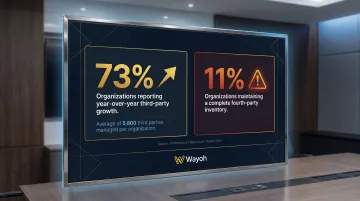
Fintech integrations, cloud migrations, AI-driven tools, and payment processing partnerships have expanded vendor portfolios significantly. According to KPMG's 2026 Global TPRM Survey of 851 organizations, 73% report year-over-year growth in third-party relationships, with the average organization now managing approximately 5,800 third parties. A one-person TPRM function cannot credibly oversee that volume.
Fourth-party risk adds another layer. The 2023 guidance explicitly directs banking organizations to evaluate risks from a vendor's own subcontractors—yet only 11% of organizations maintain a complete fourth-party inventory. Examiners are already testing for this; it's not a future consideration.
What Happens When TPRM Is Under-Resourced
The OCC issued consent orders against two institutions in late 2024 that explicitly cited third-party and risk management deficiencies:
- TD Bank (October 2024) — consent order tied in part to vendor oversight failures
- USAA Federal Savings Bank (December 2024) — cited gaps in risk management program structure
These aren't abstract cautionary tales. They're direct financial and reputational consequences of understaffed TPRM functions.
Institutions that hire ahead of their vendor growth curve avoid this outcome. Those that hire reactively, after an exam finding or an incident, face longer remediation timelines and a compressed search window — and urgency rarely produces better candidates.
Key TPRM Roles to Build Into Your Financial Institution
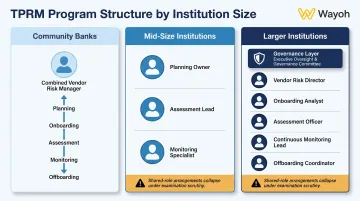
Program structure should reflect institution size and maturity. A quick reference:
| Institution Type | Recommended Structure |
|---|---|
| Community banks | Combined Vendor Risk Manager owning most lifecycle stages |
| Mid-size institutions | Dedicated ownership across planning, assessment, and monitoring |
| Larger institutions | Separated roles across all lifecycle stages plus governance |
Shared-role arrangements at mid-size and larger institutions tend to collapse under examination scrutiny.
Vendor Risk Analyst
The entry-to-mid-level workhorse of any TPRM function. Core responsibilities include:
- Executing vendor risk assessments using standardized frameworks
- Collecting and reviewing vendor documentation (SOC 2 Type II reports, audit findings, insurance certificates)
- Maintaining the vendor inventory and tiering vendors by criticality
- Flagging gaps in vendor responses and escalating material findings
What separates a strong analyst from a form-filler is follow-through. Anyone can collect a questionnaire. The better candidates chase incomplete responses, understand what a SOC 2 exception actually means, and escalate findings with context rather than just checking a box.
TPRM Program Manager / VP of Vendor Risk
This is the hardest role to fill, and the one institutions most frequently mis-scope. The Program Manager designs the TPRM framework, works directly with regulators during examinations, and ensures policies track with interagency guidance as it evolves.
Strong candidates must think strategically about program architecture and translate vendor risk exposure clearly for Board members with limited technical context — two skills that rarely come together.
The candidate pool with genuine experience in both dimensions — regulatory fluency and program design — is thin. Prioritize sourcing from regulatory agencies, Big Four advisory practices, and institutions that have recently undergone formal TPRM examinations.
Third-Party Due Diligence Specialist
Focused specifically on pre-onboarding assessment, this role has grown as fourth-party risk has become a regulatory priority. Responsibilities include:
- Deep-dive reviews of prospective vendors' compliance histories and financial stability
- Cybersecurity posture evaluation, including review of penetration testing results and vulnerability management practices
- Mapping subcontractor dependencies to identify concentration and fourth-party exposures
- Producing due diligence findings that translate into contract negotiation positions
Strong candidates often come from internal audit, cybersecurity, or regulatory compliance backgrounds. The common thread: they've been trained to test whether controls actually work, not just confirm they exist on paper.
Ongoing Monitoring and Contract Oversight Specialist
Post-onboarding oversight is where many institutions fall short. This role tracks SLA performance, reviews periodic audit reports, flags material changes in vendor financial health or leadership, and manages contract renewals with appropriate risk protections embedded.
It sits at the intersection of legal, compliance, and procurement. Candidates with hands-on exposure across more than one of those functions consistently outperform those siloed in just one.
TPRM Governance and Reporting Analyst
As regulators scrutinize governance documentation more intensively, larger institutions are carving this out as a standalone function. Responsibilities include Board and executive reporting on third-party risk exposure, maintaining documentation aligned with regulatory expectations, and coordinating independent TPRM reviews. This role typically emerges at institutions with mature TPRM programs and large vendor portfolios where reporting volume alone justifies dedicated headcount.
Skills and Qualifications to Prioritize When Hiring TPRM Professionals
Regulatory Literacy Is Non-Negotiable
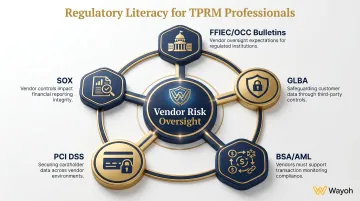
TPRM candidates must demonstrate working knowledge of:
- FFIEC guidance and OCC Bulletins (including 2023-17)
- GLBA requirements for safeguarding customer data held by service providers
- BSA/AML obligations as they apply to third-party payment processors
- PCI DSS third-party security assurance requirements
- SOX internal control implications for vendors handling financial reporting data
The test isn't whether a candidate can name these frameworks—it's whether they can translate regulatory language into vendor contract terms and operational controls. Ask candidates to walk you through how they've operationalized a specific regulatory requirement in a vendor relationship.
Risk Assessment Methodology and Vendor Tiering
Look for candidates who can articulate how they tier vendors by criticality, apply risk-based due diligence proportionate to that tiering, and develop or refine standardized assessment methodologies. Ad hoc approaches break down as portfolios scale. Candidates who have built or improved assessment frameworks bring more value than those who've only executed them — they know where the gaps appear before regulators do.
Cybersecurity Fundamentals for Technology Vendor Oversight
For institutions with significant fintech or cloud vendor exposure, cybersecurity evaluation skills are no longer optional. Look for candidates who can:
- Review and interpret SOC 2 Type II reports, including exception items
- Assess security questionnaire responses for substantive gaps versus checkbox compliance
- Identify material vulnerability management deficiencies that signal real exposure
These skills are hard to find in generalist risk candidates — and they're exactly what regulators expect to see in vendor oversight programs.
Certifications That Signal Depth
| Certification | Best Suited For |
|---|---|
| CTPRP (Certified Third-Party Risk Professional) | Senior TPRM roles; most directly role-specific credential |
| CRISC (Certified in Risk and Information Systems Control) | Technology-heavy vendor portfolios |
| CISA (Certified Information Systems Auditor) | Audit-adjacent TPRM and IT vendor oversight |
| CAMS (Certified Anti-Money Laundering Specialist) | Roles with significant BSA/AML vendor oversight |
Certification signals preparation, not competence. A CTPRP holder who has never defended a vendor risk assessment finding to a regulator is less useful than an uncertified candidate who has done it twice. Weight credentials alongside evidence of applied experience.
Soft Skills That Get Underweighted
TPRM professionals negotiate with vendors who often have more leverage—core banking vendors, large SaaS providers, major payment processors. They communicate risk findings to executives who may not understand what a SOC 2 exception means. They push procurement teams to follow controls that slow down vendor onboarding.
During interviews, assess for:
- Specific examples of vendor negotiations where the candidate held a risk position under commercial pressure
- How they've communicated a material risk finding to a non-technical audience
- Situations where they influenced an internal stakeholder to follow a procurement control they resisted
How to Structure a TPRM Hiring Strategy That Works
Start With a Gap Analysis, Not a Job Description
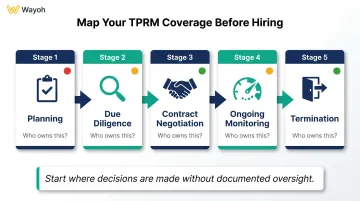
Institutions that jump straight to writing a job description frequently hire for the wrong level or scope. Before posting a role, map your current coverage against the five lifecycle stages: planning, due diligence, contract negotiation, ongoing monitoring, and termination. Where are decisions being made without documented oversight? Where would an examiner find gaps? That's where your first hire should focus.
Write Job Descriptions That Reflect Actual Regulatory Requirements
Vague job descriptions attract generalist candidates. "Responsible for managing vendor relationships" will surface procurement coordinators, not TPRM professionals. Specificity works better—for example: "Experience preparing vendor risk reporting for Board-level review in accordance with OCC/FDIC interagency guidance" or "Demonstrated ability to evaluate third-party cybersecurity posture through SOC 2 Type II review and security questionnaire analysis."
The more precisely your job description maps to actual examination expectations, the more precisely your candidate pool will match.
Consider Permanent and Contract-to-Hire Based on Urgency
According to ISACA's 2025 State of Cybersecurity report, 38% of organizations report it takes 3–6 months to fill entry-level risk roles, with similar timelines for non-entry-level positions. That timeline is incompatible with regulatory remediation deadlines.
Contract TPRM professionals are well-suited for:
- Regulatory examination preparation
- Program buildouts with defined deliverables
- Remediation projects requiring specific documentation outputs
- Surge capacity during vendor portfolio expansions
A blended model—permanent program lead supported by contract analysts—often accelerates time-to-competency while keeping costs manageable.
Partner With a Recruiter Who Knows This Market
Once you've settled on your hiring model, finding the right recruiter is the next critical decision. General job boards rarely surface candidates with the combination of regulatory depth and vendor lifecycle experience that TPRM requires. The most qualified professionals aren't typically active job seekers—they're employed and being contacted directly.
Wayoh's human-first, network-first model reaches those passive candidates through direct relationships, not database searches. For TPRM roles, that approach delivers on three fronts:
- Shorter time-to-fill in a narrow candidate market
- Higher first-year retention from better role-fit alignment
- Reduced mis-hire risk where regulatory credibility is on the line
With over 3 years of financial services hiring and 500+ placements in compliance and risk, Wayoh's direct-contact recruiting is built specifically for roles like these.
Common TPRM Hiring Mistakes and How to Avoid Them
Treating TPRM as a Subset of a General Compliance Role
Combining TPRM responsibilities with broad compliance duties, without dedicated headcount, results in neither function being done well. Regulators are increasingly looking for documented evidence of dedicated TPRM oversight.
The interagency guidance explicitly calls for "independent reviews" of TPRM processes — implying a distinct function, not shared-role coverage. If TPRM is one of eight responsibilities on a compliance officer's job description, an examiner will notice.
Prioritizing Credentials Over Practical Experience
A credentialed candidate who has never built a vendor risk assessment, managed a critical vendor incident, or presented TPRM findings to a Board is a significant hire risk. Use interviews to surface real-world experience:
- "Walk me through a vendor relationship where you identified a material risk—what was the finding, how did you escalate it, and what was the outcome?"
- "Describe how you've structured a vendor tiering methodology. What criteria did you use, and how did it change your due diligence approach?"
- "Have you ever been in a TPRM examination—what did the examiner focus on, and how did you prepare the documentation?"
Candidates who've lived these scenarios answer differently than those who've only read about them — and that gap matters when a regulator is at the door.

Failing to Plan for Staff Turnover
TPRM professionals with regulatory examination experience are actively recruited. 55% of cybersecurity and risk teams are currently understaffed, and 50% of organizations struggle to retain this talent (ISACA 2025). When a key TPRM hire departs, program continuity depends on whether their knowledge lived in their head or in documented procedures.
Build documentation protocols and cross-training into the TPRM talent strategy from day one—not as an afterthought when someone gives notice.
Frequently Asked Questions
What does a Third-Party Risk Manager do in a financial institution?
A Third-Party Risk Manager oversees the full vendor lifecycle: due diligence before onboarding, ongoing performance and compliance monitoring, and managing contract exits. The role ensures vendor relationships align with OCC, FDIC, and Federal Reserve guidance.
What qualifications should a TPRM analyst have in financial services?
Strong TPRM analysts know FFIEC guidance, BSA/AML, and GLBA, and have hands-on experience with vendor risk assessment frameworks. Certifications like CTPRP or CRISC help, but practical experience executing assessments and reviewing SOC 2 reports matters as much.
How large should a TPRM team be for a mid-sized bank?
Team size should reflect the number of critical vendor relationships, the complexity of the vendor ecosystem, and the institution's examination history. A mid-sized bank managing 50 or more vendors typically needs at least two dedicated TPRM professionals to credibly cover due diligence and ongoing monitoring simultaneously.
What is the difference between a TPRM role and a general compliance role?
TPRM roles focus specifically on risks introduced by external vendors—requiring expertise in vendor due diligence, contract risk protections, and ongoing performance monitoring. General compliance roles typically focus on internal regulatory adherence across the institution's own operations, not on managing third-party relationships.
What certifications are most valued for TPRM professionals in banking?
The CTPRP (Certified Third-Party Risk Professional) is the most role-specific credential. CRISC and CISA are valued for technology-heavy vendor portfolios, and CAMS is most relevant for roles with significant BSA/AML vendor oversight responsibilities.
Should financial institutions hire permanent TPRM staff or use contractors?
Permanent hires build institutional knowledge over time, while contract professionals suit program buildouts, examination remediation, or surge capacity needs. Many institutions run a blended model, pairing permanent leadership with contract support to balance speed and continuity.