

Introduction
Regulated industries don't get the luxury of a slow hire. When a BSA officer leaves without notice, a fintech prepares for an OCC examination, or a healthtech company needs HIPAA coverage before a product launch, the typical 60–90 day permanent search isn't a viable option — it's a liability.
The pressure is structural, not cyclical. The Federal Register contained 3,248 final rules in 2024, an 8% increase over the prior year, while nearly 70% of organizations report difficulty recruiting qualified candidates for full-time roles.
Banks, fintechs, and healthtech companies are caught between accelerating regulatory demands and a shrinking pool of specialists who can meet them.
Interim recruiters exist precisely for that gap. This article covers what an interim recruiter actually is, how they differ from a standard permanent agency, and why regulated-industry firms rely on them to fill compliance, risk, and legal roles fast.
Key Takeaways
- An interim recruiter sources and places experienced professionals in temporary or fixed-term roles — typically faster than permanent hiring
- Particularly valuable in banking, fintech, and healthtech where compliance gaps create real regulatory exposure
- Contract lengths generally range from one to twelve months, scoped to a project or coverage need
- Offers speed of placement, day-rate billing, minimal onboarding, and no long-term headcount commitment
- Best suited for regulatory audits, M&A transactions, sudden vacancies, and rapid scaling phases
What Is an Interim Recruiter?
An interim recruiter is a staffing specialist who sources and places experienced professionals into temporary, contract, or fixed-term roles within a company. The role has a defined start date, a specific scope, and a planned end point — which makes the search faster and more targeted than a permanent hire.
One term worth clarifying: "interim recruiter" gets used two ways. It can refer to the staffing specialist running the search (the firm or individual placing the candidate) or the professional brought in to temporarily fill a role. This article focuses on the former — the recruiter who runs interim searches.
Interim Recruiter vs. Interim Professional: Clarifying the Terms
The staffing specialist and the placed professional interact throughout the process, but their roles are distinct:
- The interim recruiter manages the search, maintains a network of available candidates, handles vetting, and facilitates placement
- The interim professional is the experienced hire who steps into the role — a compliance officer, BSA analyst, risk manager, or privacy counsel filling a defined gap
In banking, fintech, and healthtech, the roles an interim recruiter most commonly fills include:
- BSA/AML analysts and compliance officers
- Enterprise risk managers and credit risk specialists
- In-house legal counsel and privacy officers
- KYC and sanctions specialists
- IT security leads and data governance managers
These aren't generalist positions. They require deep knowledge of specific regulatory frameworks, and a wrong hire — or a prolonged vacancy — carries direct legal and financial risk.
How Interim Recruiters Source Differently
That regulatory depth makes sourcing harder than it looks. A standard job posting won't reach the best compliance talent — most qualified professionals are already employed, not actively searching, and won't respond to a LinkedIn ad.
Interim recruiters maintain live networks of pre-vetted professionals with known availability. Sourcing is relationship-driven, built through years of direct market engagement rather than keyword matching. That's what makes fast shortlisting possible for hard-to-fill roles. Wayoh, for example, engages both active and passive candidates through direct relationships developed over 10+ years in regulated industry hiring — guided by a human-first recruiting philosophy rather than database queries alone.
Interim Recruiter vs. Permanent Recruiting Agency: Key Differences
The distinction matters when you're choosing a hiring partner under time pressure.
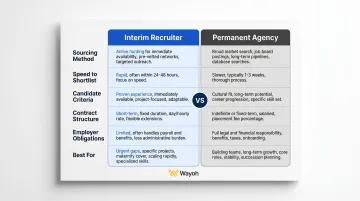
| Factor | Interim Recruiter | Permanent Agency |
|---|---|---|
| Sourcing method | Live, warm talent networks | Post-and-search, job advertising |
| Speed to shortlist | Days | Weeks to months |
| Candidate criteria | Proven track record, immediate productivity | Culture fit, growth trajectory |
| Contract structure | Day rate or fixed-term fee | Percentage of first-year salary |
| Employer obligations | None (no benefits, sick pay, or redundancy) | Full permanent employment costs |
| Best for | Defined projects, urgent gaps | Long-term team building |
The Cost Model Difference
Permanent agency fees are typically calculated as a percentage of the placed candidate's base salary. For a senior compliance hire earning $90,000–$104,000 (per BLS data for high-cost markets like Washington, D.C.), that fee adds up quickly, on top of benefits, onboarding, and ramp-up time.
Interim placements operate on a day rate or fixed-term contract. The company pays for the engagement period and nothing more — no employer benefit contributions, no paid leave obligations, no redundancy exposure. For early-stage fintechs or healthtech startups managing tight budgets, that often means the difference between filling a critical gap now and waiting months while headcount approvals stall.
Why Banking, Fintech & Healthtech Companies Rely on Interim Recruiters
Regulated industries face hiring pressures that standard recruitment timelines simply aren't built to handle. Here's why interim recruiters have become a practical necessity across banking, fintech, and healthtech.
Regulatory Velocity Outpacing Permanent Hiring
Compliance demands don't wait for a 90-day search to close. Thomson Reuters Regulatory Intelligence tracks an average of 200 regulatory changes and announcements daily across international financial services. New AML/CFT program requirements, OCC enforcement actions, SEC rule changes, and HIPAA amendments create sudden, time-sensitive demand for specialists.
When a bank receives a consent order or a fintech needs BSA coverage before a charter application, the median 45-day time-to-fill for a permanent role isn't fast enough. The cost of getting this wrong is concrete: TD Bank's $3 billion AML settlement in 2024 and FinCEN's $80 million penalty against Canaccord Genuity in 2026 are evidence of what understaffed compliance functions actually cost.
Rapid Scaling in Fintech and Healthtech
Global fintech revenues reached $650 billion in 2025, growing at 21% year-over-year, while 21 fintechs applied for U.S. banking charters in 2025 alone. Digital health funding rose to $22.3 billion in 2025. Both sectors are scaling faster than internal HR functions can absorb.
Adding permanent headcount at this pace isn't always viable. Interim professionals let these companies add compliance, legal, and risk capacity immediately — without overextending their permanent payroll.
Project-Based Hiring Triggers
Many regulated-industry hiring needs are inherently temporary:
- Mergers and acquisitions — requiring immediate legal and risk support during due diligence and integration
- Regulatory audits — demanding compliance resources for a defined examination window
- Banking charter applications — requiring BSA/AML infrastructure buildout for a defined project period
- System implementations — needing privacy and security expertise during rollout
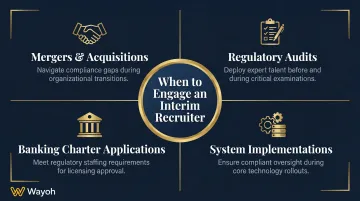
An interim recruiter can staff these engagements quickly and wind them down cleanly when the project concludes.
Access to Passive Talent
The most qualified compliance and risk professionals aren't browsing job boards. Firms that specialize in regulated-industry hiring maintain ongoing relationships with passive candidates — people who would consider the right opportunity but won't respond to a job posting. Reaching this talent tier requires years of market presence, not a LinkedIn search.
That's the foundation of Wayoh's model: 10+ years and 500+ placements in banking, fintech, and healthtech, built on direct relationships rather than reactive sourcing.
Key Benefits of Using an Interim Recruiter in Regulated Industries
Speed of Placement
A full-time compliance hire takes 3–5 months from job posting through onboarding, according to LawFlex. SHRM's 2025 benchmarking data puts the median time-to-fill at 45 days for all roles, stretching to 61 days at large organizations.
An interim recruiter with a live, pre-vetted network can compress that to days. For regulated functions, every unfilled day is active exposure — Stout's 2025 analysis of AML programs found that staffing inadequacy leads directly to untimely alert reviews, incomplete investigations, and regulatory violations.
Cost Efficiency
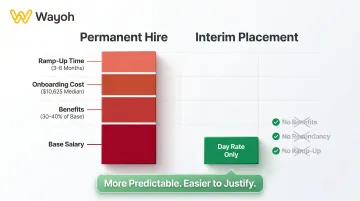
Interim hiring avoids the full cost burden of permanent employment:
- No employer benefit contributions
- No paid leave or sick pay obligations
- No redundancy costs if the engagement ends early
- No long ramp-up period eating into productivity
For comparison, SHRM data puts the median cost-per-hire for executive roles at $10,625 — and that's before salary, benefits (typically 30–40% of base), and onboarding. For a defined-term engagement, that cost profile is far more predictable — and far easier to justify to a finance committee.
Immediate Productivity
Experienced interim compliance and risk professionals arrive knowing the environment. A BSA officer placed through a specialist recruiter doesn't need a six-week regulatory orientation. They know the frameworks, the filing requirements, and the operational norms — and they're expected to contribute from day one.
Wayoh vets all interim candidates with references and background checks before introduction — a non-negotiable step for roles involving access to sensitive financial data, customer records, or regulatory filings.
Flexibility Without Long-Term Commitment
Contract lengths can be adjusted, extended, or closed out based on what the project requires. A company can staff up for an audit cycle, an M&A transaction, or a remediation effort — then return to baseline headcount once the work is done. Permanent hires don't offer that option.
Risk Mitigation
An interim compliance officer costs a fraction of what a regulatory penalty does. Leaving a compliance function unstaffed for three months — during an active examination, a product launch, or an AML remediation — isn't a budget decision. It's a risk decision. Interim staffing puts a defined timeline and a qualified professional on an exposure that would otherwise stay open-ended.
How to Choose the Right Interim Recruiter for Your Industry
A generalist firm that happens to have compliance candidates on file is not the same as a recruiter who has spent years sourcing within your specific regulatory environment. The difference shows up in candidate quality and placement speed.
Questions Worth Asking Any Interim Recruiter
Before engaging a firm, probe their actual depth:
- What regulatory frameworks do your compliance candidates hold expertise in — BSA/AML, CAMS, CRCM, HIPAA, SOC 2?
- What is your average time from role briefing to candidate shortlist for compliance or risk functions?
- How many pre-vetted candidates do you have available right now in this specific function?
- What does your vetting process include — reference checks, background screening, regulatory knowledge assessment?
- Do you have direct relationships with passive candidates not currently job-searching?
Evaluating Network Depth and Sector Fit
Ask for specifics. A recruiter who genuinely specializes in your sector will know the difference between an OCC-regulated bank and a state-licensed fintech, and will source accordingly. They should be able to discuss CFPB enforcement posture, FinCEN guidance, or FDA staffing pressure without prompting.
That depth of sector knowledge is what separates a placement partner from a resume forwarder. Wayoh, for instance, focuses exclusively on compliance, risk, and legal hiring across banking, fintech, and healthtech — with 500+ placements across New York, California, and Florida. Their process includes upfront conversion fee disclosure and weekly engagement with placed consultants, structured for the speed and sensitivity regulated environments require.
Frequently Asked Questions
What is an interim recruiter?
An interim recruiter is a staffing specialist who sources and places experienced professionals into temporary or fixed-term roles. They maintain active talent networks and direct candidate relationships, which allows them to fill positions significantly faster than a traditional permanent search agency.
How long does an interim position last?
Interim contracts typically range from one month to twelve months, depending on the project scope or coverage need. Engagements can be extended if the business need continues, or ended early if circumstances change. Either way, both parties retain flexibility that a permanent hire doesn't provide.
Is it good to accept an interim position?
For candidates in compliance and risk, interim roles offer access to senior-level experience across multiple regulated environments, competitive day rates, and schedule flexibility. Demand for interim compliance talent remains consistently high, making it a strong career path for experienced professionals.
Is acting or interim better?
An "acting" role typically refers to an internal employee stepping up temporarily, while an "interim" hire is an external professional brought in with a defined mandate. For regulated functions, interim hires often bring more specialized expertise and an impartiality that which regulators and boards tend to value.
When should a banking or fintech company hire an interim recruiter?
Common signals include a sudden compliance vacancy, an approaching regulatory audit, an M&A transaction requiring immediate legal or risk coverage, or a growth phase that outpaces permanent hiring timelines. If the need is time-sensitive and the function is regulated, an interim recruiter should be the first call.
How is an interim recruiter different from a permanent recruiting agency?
Interim recruiters rely on live talent networks and relationship-driven sourcing to fill roles in days, while permanent agencies typically conduct broader searches over weeks or months. The billing model also differs: interim placements are charged on a day rate or fixed-term fee, not as a percentage of annual salary.