
Introduction
Hiring technology talent is already competitive. Hiring compliance-aware technology talent — for a bank, a fintech, or a health system — is a different problem entirely.
Most IT staffing models weren't built with regulatory obligations in mind. A developer who spent three years building SaaS dashboards is not the same as an engineer who understands why PCI-DSS applies to a payment processing pipeline, or why a HIPAA-compliant data architecture looks fundamentally different from a standard cloud build.
Many companies in these sectors turn to generalist IT staffing firms and then spend weeks untangling the mismatch — or worse, discover the problem after a contractor has already touched production systems.
This guide covers what technology staff augmentation actually is, why it looks different in regulated industries, which roles it applies to, and how to identify a staffing partner with the domain depth these industries actually require.
What Is Technology Staff Augmentation?
TLDR:
- External tech professionals join your team temporarily, working under your direction
- You retain full management control, IP ownership, and compliance accountability
- Unlike outsourcing, the work stays inside your team's chain of command
- Placement timelines are days to weeks — not the 44–71 days typical of permanent hiring in regulated industries
- Built for regulated environments where internal ownership of technology decisions is required
Technology staff augmentation is a model where external IT and engineering professionals join your existing team on a temporary basis — working under your direction, inside your workflows, reporting to your internal leads. They fill skill gaps, expand team capacity, or execute defined projects — without adding permanent headcount.
How It Differs From Outsourcing
The distinction matters most in regulated environments. With staff augmentation, your organization retains:
- You assign work, set priorities, and run standups
- All work product belongs to your organization
- The contractor operates within your compliance framework, not a vendor's
With outsourcing, work direction and accountability transfer to the vendor. For banks, fintechs, and health systems where audit trails require demonstrable internal ownership of technology decisions, that distinction directly affects how auditors assess your compliance posture.
The Case Against Permanent Hiring Here
Two practical advantages stand out:
- No long-term salary or benefits commitment — the engagement ends when the project does
- Placements happen in days or weeks, not the months that permanent technology hiring typically requires in regulated sectors
Why Banking, Fintech & Healthtech Face Unique Technology Hiring Challenges
Regulated industries don't just need tech talent. They need tech talent with industry context — and that's a much smaller pool.
The compliance context isn't incidental — it's load-bearing:
- A payment systems engineer needs working knowledge of PCI-DSS before touching transaction flows
- A healthcare data engineer must understand HIPAA's implications for architecture decisions, not just storage
- A financial crime specialist needs BSA/AML familiarity before writing a single line of transaction monitoring logic
The Talent Shortage Is Structural
The numbers make this concrete. According to the ISC2 2025 Cybersecurity Workforce Study, 95% of cybersecurity teams have at least one skills deficiency, with cloud security (36%) and risk assessment (29%) among the most cited gaps. ISACA's 2025 data shows **57% of organizations report being understaffed in cybersecurity** — and that's before adding the compliance-aware overlay that banking and healthcare require.
Meanwhile, the Bureau of Labor Statistics projects 29% growth for information security analysts through 2034 — roughly ten times the average for all occupations. Demand is accelerating faster than the talent pipeline can respond.
Vendor Onboarding Is Not Optional
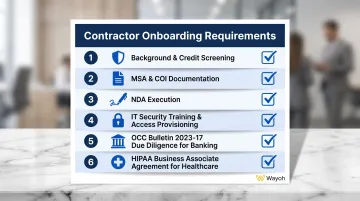
The talent shortage is only part of the problem. Even after you find the right candidate, getting them operational in a regulated environment takes considerably more than a contract and a laptop. In banking and healthcare, onboarding involves:
- Background and credit screening
- MSA and COI documentation
- NDA execution
- IT security training and access provisioning
- In banking: compliance with OCC Bulletin 2023-17, which mandates multi-step third-party due diligence for all national banks
- In healthcare: HIPAA Business Associate Agreements for any contractor accessing protected health information
Recruiters without regulated-industry experience routinely underestimate this process — which turns a two-week start date into a six-week delay.
The Cost of Getting It Wrong
This isn't about project delays. Healthcare data breaches average $10.93 million per incident. Financial sector breaches average $5.9 million. TD Bank's 2024 AML enforcement action totaled $3.09 billion — the largest BSA penalty in U.S. history.
A contractor with no compliance awareness who accesses the wrong system, structures data incorrectly, or mishandles PHI doesn't just slow a project down. At those breach and penalty figures, a single misstep can exceed the cost of an entire technology program.
Key Technology Roles Accessed Through Staff Augmentation in Regulated Industries
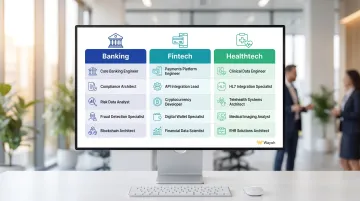
Regulated industries don't just need more hands — they need the right expertise at the right time. The roles below represent the technology functions most commonly filled through staff augmentation, each carrying compliance obligations, security requirements, or regulatory context that generic IT staffing models rarely accommodate.
Banking: Core Systems, Compliance, and Cloud Roles
| Role | Primary Function |
|---|---|
| Core banking systems engineers | Legacy and modern core platform development, integration, migration |
| Fraud and AML detection developers | Transaction monitoring systems, rules engines, alert logic |
| Regulatory reporting and data engineers | Call reports, regulatory data pipelines, data quality frameworks |
| Cloud migration architects (FS-experienced) | Cloud lift-and-shift with financial services security controls |
| Digital banking / API integration developers | Open banking APIs, mobile banking platforms, third-party integrations |
Fintech: Payments, Risk, and Security Roles
| Role | Primary Function |
|---|---|
| Payments infrastructure engineers | Payment rails, settlement logic, card processing systems |
| Open banking API developers | API design, data sharing frameworks, third-party connectivity |
| KYC/identity verification specialists | Identity verification workflows, document review automation |
| Data scientists for credit risk and underwriting | Model development, scoring logic, risk decisioning |
| Cybersecurity engineers (fintech/payments) | AppSec, cloud security, infrastructure hardening |
Healthtech: HIPAA, Interoperability, and Clinical Data Roles
| Role | Primary Function |
|---|---|
| HIPAA-compliant backend and data engineers | PHI-aware data architecture, secure storage and processing |
| EHR/EMR integration developers | System integration with major EHR platforms |
| Telehealth platform engineers | Video infrastructure, patient-facing application development |
| HL7/FHIR interoperability specialists | Healthcare data exchange, ONC/CMS-mandated API development |
| Clinical data and analytics engineers | Clinical datasets, outcomes reporting, population health analytics |
How Technology Staff Augmentation Works in Regulated Industries
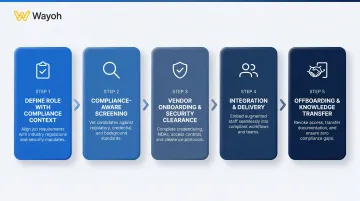
Staff augmentation in banking, fintech, and healthtech follows a more structured path than general IT staffing. Every step — from role definition to offboarding — carries compliance obligations that a generalist partner may not anticipate.
Step 1 — Define the Role With Compliance Context
Beyond the standard job description fields, regulated-industry roles require upfront clarity on:
- What systems or data the contractor will access
- Which compliance frameworks apply (HIPAA, PCI-DSS, SOX, BSA/AML)
- What background check tier is required
- Whether vendor management pre-approval is needed before sourcing begins
The more precisely this is defined, the faster and more accurately a specialized partner can match.
Step 2 — Compliance-Aware Screening
A specialized staffing partner doesn't keyword-match resumes. For regulated industries, screening should include:
- Verification of prior regulated-industry experience (not just adjacent roles)
- Assessment of compliance framework familiarity — not self-reported, but explored through direct conversation
- Reference checks from prior regulated-industry engagements specifically
- Background screening before a candidate is presented, not after offer
Wayoh's human-first screening approach emphasizes direct candidate conversations and domain-specific evaluation over automated matching — assessing regulatory fit alongside technical capability.
Step 3 — Vendor Onboarding and Security Clearance
Vendor onboarding is where many placements lose momentum. Requirements typically include:
- MSA review and legal sign-off
- Certificate of Insurance requirements
- NDA execution
- IT security training completion
- Access provisioning (which often requires its own change management approval)
A staffing partner with regulated-industry experience anticipates this process and builds it into the placement timeline rather than treating it as an obstacle discovered post-offer.
Step 4 — Integration and Delivery
The augmented professional works as part of your team: attending standups, following your internal change control and ticketing processes, and reporting to your internal leads. Your organization retains full project direction and accountability.
That internal ownership chain matters in regulated environments. Auditors need to see that technology decisions were directed and approved internally — not delegated to outside contractors without oversight.
Step 5 — Offboarding and Knowledge Transfer
Regulated offboarding isn't optional or informal. It requires:
- Access revocation across all systems and environments
- Documentation handover and knowledge transfer
- Return or destruction of any sensitive data per HIPAA or banking security requirements
- Exit confirmation for security and audit purposes
In fintech and healthcare especially, contractor access to sensitive data must be cleanly and documentably closed. A missed access revocation or incomplete data handover isn't just an operational gap — it's a potential audit finding.
Staff Augmentation vs. Other Hiring Models for Regulated Tech Teams
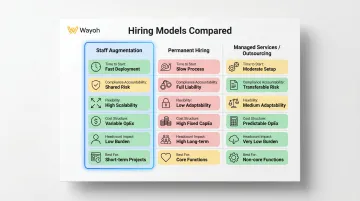
Comparison Table
| Dimension | Staff Augmentation | Permanent Hiring | Managed Services / Outsourcing |
|---|---|---|---|
| Time to start | Days to weeks | 44–71 days (regulated industries) | Weeks to months (SOW negotiation) |
| Compliance accountability | Client retains | Client retains | Passes to vendor |
| Flexibility | High — scales with project | Low — long-term commitment | Medium — scope-bound |
| Cost structure | Hourly/daily rate, no benefits overhead | Salary + benefits + recruiting cost | Fixed or variable fee, less transparent |
| Headcount impact | Typically outside headcount restrictions | Counts against headcount | Varies by structure |
| Best for | Projects, migrations, scaling phases, hiring freezes | Core long-term functions | Defined, contained workstreams |
When Permanent Hiring Is Clearly Better
Permanent hires make more sense when the role requires accumulated institutional context that can't be handed off or ramped quickly. That typically means:
- Foundational systems ownership where years of context directly affect decision quality
- Regulatory relationships built over time (examiner familiarity, audit history, compliance program authorship)
- Core team integration where long-term culture fit outweighs speed-to-productivity
Staff augmentation fills gaps and accelerates projects — but it works best alongside a stable permanent core, not instead of one.
When Staff Augmentation Wins
- Core banking modernization projects with defined timelines
- RegTech platform buildouts ahead of regulatory deadlines
- Fintech or healthtech engineering scale-ups during growth phases before permanent headcount is approved
- Compliance-driven overhauls requiring specialized skills outside the permanent team's existing capability
- Hiring freezes — contract professionals typically fall outside headcount restrictions, keeping projects moving when budgets are locked
What to Look for in a Technology Staffing Partner for Regulated Industries
Not all IT staffing firms are equipped to serve regulated environments. The selection criteria here are different in ways that matter from general IT staffing.
Ask About Domain Depth Before Anything Else
A partner who cannot distinguish between a BSA compliance officer and a BSA technology engineer will not screen candidates correctly. Ask directly: what percentage of your placements have been in banking, fintech, or healthtech? What compliance frameworks do your recruiters know how to assess candidates against?
Vetting Depth Beyond Resume Review
Understand exactly what the firm's screening process covers:
- Background and credit screening (before presentation, not after offer)
- Compliance framework knowledge assessment through direct conversation
- Reference checks from prior regulated-industry engagements specifically
- Technical and domain evaluation together, not separately
Volume-based generalist firms often stop at keyword matching. A wrong placement in a regulated environment carries real financial exposure — average breach costs range from $5.9M to $10.93M — which vastly exceeds any placement fee.
How the Firm Manages the Relationship After Placement
The best outcomes in regulated technology hiring come from staffing partners who invest in understanding your specific environment: your compliance stack, your vendor policies, your internal team structure, your change management process.
A relationship-led model produces better initial matches and faster subsequent placements because the partner carries forward context from prior engagements. Look for firms that offer transparent communication, structured updates during active searches, and engagement support after a hire is made — not just during it.
Track Record in the Relevant Verticals
Ask for examples of prior placements in banking, fintech, or healthtech technology roles. A firm with 10+ years of financial services staffing experience and hundreds of placements in regulated industries carries a meaningful advantage over a generalist IT firm treating these sectors as a new revenue stream.
The depth matters because regulated-industry hiring carries risks — regulatory, operational, and reputational — that don't exist in general IT staffing, and experience is what makes those risks manageable.
Wayoh's recruiting practice is built on over 3 years of regulated-industry hiring, with 500+ placements across banking, fintech, and healthtech. Recruiters assess candidates against AML, KYC, HIPAA, BSA, and sanctions frameworks as part of every standard search.
Frequently Asked Questions
What is technology staff augmentation?
Technology staff augmentation is a model where external tech professionals join your existing team temporarily, working under your direction and within your systems. Unlike outsourcing (where you hand over work direction), you retain full management control, IP ownership, and compliance accountability throughout the engagement.
What is the IT staff augmentation process?
The core steps are:
- Define the role and its compliance requirements
- Partner with a specialized staffing firm to source and screen candidates
- Complete vendor onboarding and security clearance
- Integrate the professional into your team under your management
- Offboard at engagement close with access revocation and documentation handover
How much does staff augmentation cost?
Costs vary by role seniority, engagement duration, and sector. Regulated-industry roles in banking, fintech, and healthtech typically command a premium over generalist IT placements due to required domain experience and compliance screening. Request a scoped estimate from your staffing partner based on the specific role — generic benchmarks rarely apply here.
What is an example of staff augmentation?
A common example: a healthtech startup brings in a HIPAA-compliant data engineer to build out its patient data infrastructure ahead of a product launch. The contractor is fully vetted, onboarded within the client's compliance framework, and managed directly by the client's team throughout.
Is staff augmentation a good option for compliance-sensitive technology roles?
It is, provided the staffing partner has genuine regulated-industry experience and performs compliance-aware screening. The client retains full management control throughout, which satisfies the internal ownership requirements that regulators and auditors look for in technology decision chains.
How is staff augmentation different from outsourcing for regulated technology teams?
With staff augmentation, the client directs the work and retains compliance accountability — the contractor operates within your frameworks, not a vendor's. With outsourcing, work direction and accountability transfer to the vendor, which can create significant regulatory complexity for banks, fintechs, and health systems that must demonstrate internal ownership of technology decisions to auditors.