Introduction
Finding the right engineering talent for fintech or healthtech isn't a recruiting problem — it's a compliance problem disguised as one. And most hiring teams aren't equipped to tell the difference.
Compliance requirements, niche tech stacks, and regulatory risk create a talent gap that generic hiring methods consistently fail to close.
An engineer who excels at building distributed systems but has never worked with HIPAA-compliant data architecture or PCI DSS payment infrastructure isn't just underqualified — that hire becomes a direct regulatory risk.
Specialized tech recruiters solve this. They bring pre-vetted talent networks, regulatory screening depth, and the speed that regulated environments demand — compressing timelines that internal teams simply can't match alone.
This guide covers what makes fintech and healthtech engineering hiring uniquely difficult, what elite teams in these sectors actually look like, how specialized recruiters create a concrete hiring advantage, and what to look for when choosing a recruiting partner.
Key Takeaways
- Fintech and healthtech roles demand both technical skill and regulatory fluency — SOC 2, PCI DSS, and HIPAA expertise are baseline requirements
- Specialized recruiters with pre-vetted candidate networks cut 3–4 month hiring cycles down to weeks
- Interim engineers serve as a strategic asset for compliance projects, platform migrations, and leadership gaps
- When evaluating a tech recruiter, prioritize regulatory depth and relationship-led sourcing over raw placement volume
Why Engineering Hiring in Fintech & Healthtech Is a Different Game
The Compliance Competency Gap
Standard software engineering talent is abundant. Engineers who combine deep technical skills with working knowledge of regulatory frameworks — HIPAA, PCI DSS, SOC 2 — are not.
According to ISC2's 2023 Cybersecurity Workforce Study, **67% of organizations report cybersecurity staffing shortages**, with demand for cloud and compliance-capable engineers continuing to outpace supply. In fintech and healthtech, where regulatory controls are embedded in the code itself, this supply constraint is directly felt in every senior engineering search.
These frameworks assign real engineering obligations — not policy checkboxes:
- PCI DSS v4.0 (transition completed March 2024): MFA enforcement, WAF implementation, access control architecture, and client-side script inventory
- HIPAA 45 CFR 164.312: Access controls, audit logging, integrity verification, and transmission security — all at the engineering layer
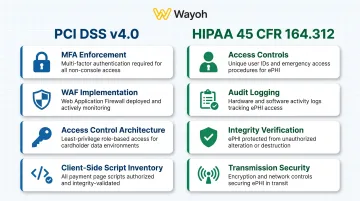
Meeting these requirements demands engineers who have actually built and shipped these controls in production, not candidates who can talk about them in an interview.
The Real Cost of a Mis-Hire
Getting a senior engineering hire wrong in a regulated environment carries consequences well beyond a wasted salary. SHRM documents cases where the total cost of a failed hire — covering recruiting, onboarding, lost productivity, and remediation — can reach $240,000. In fintech or healthtech, add potential regulatory penalties, audit failures, or data breach exposure on top of that.
A wrong hire in a payment security role or a HIPAA-governed data pipeline isn't just expensive — it's a material compliance risk. Generic screening processes weren't built to catch that distinction.
Market Competition and Geographic Concentration
That compliance risk also explains why the hiring window is so narrow. Fintech and healthtech companies aren't just competing against each other for engineering talent. They're competing against FAANG and large tech platforms — often without matching compensation packages. Fintech software engineers earn a median of around $143K according to Levels.fyi data, but big tech regularly exceeds this, compressing hiring windows and forcing companies to move faster on qualified candidates.
Geographically, fintech engineering talent clusters heavily in San Francisco and New York City, with growing activity in Miami, Los Angeles, and San Diego. Healthtech hubs mirror this pattern. Local market knowledge — understanding who is passive, who is open, and what compensation looks like in each market — is a sourcing advantage generalist recruiters don't carry.
The Niche Stack Problem
Platforms like AWS HealthLake, Plaid API integrations, and blockchain-based financial infrastructure require engineering expertise that standard job boards don't surface. Most candidates who appear qualified on paper haven't worked in these environments at depth.
A recruiter who can't articulate the difference between HL7 FHIR R4 and R5 — or who doesn't know what PCI DSS scoping means for a backend engineer — can't reliably distinguish a genuinely qualified candidate from one who just says the right words.
What Elite Engineering Teams Actually Look Like in These Sectors
Fintech Engineering: Beyond Strong Code
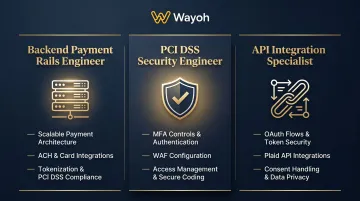
Elite fintech engineers understand payment systems, financial data security, API-first architectures, and how to navigate cross-functional regulatory teams. Three roles that illustrate this:
- Backend payment rails engineer: Designs scalable payment architectures with card network and ACH integrations, tokenization, encryption, and PCI DSS compliance built in from the ground up
- PCI DSS security engineer: Owns the cardholder data environment — MFA controls, WAF configuration, access management, and secure coding validation under v4.0 requirements
- API integration specialist: Secures connections to financial data platforms like Plaid, covering OAuth flows, token security, and consent handling that satisfy both regulatory and PCI constraints
Healthtech Engineering: Clinical Context Required
In healthtech, elite engineers combine HIPAA-compliant data architecture skills with healthcare interoperability standards — and must work effectively with clinical and legal stakeholders. Examples:
- EHR integration engineer: Builds and maintains HL7 FHIR-based connections between EHR systems, with RESTful resource handling aligned to ONC interoperability requirements
- Healthcare data engineer: Designs de-identified patient datasets for ML pipelines, with access controls and audit logging under HIPAA's technical safeguard requirements (45 CFR 164.312)
- Platform engineer (HIPAA cloud): Architects HIPAA-eligible infrastructure on platforms like AWS HealthLake, managing FHIR data stores and connecting analytics and AI tooling
The Leadership Layer and Team Composition
Technical leadership — CTOs, VP Engineering, Staff Engineers — represents the hardest profile to recruit in both sectors. These individuals must bridge product vision with compliance obligations and speak fluently to both regulators and engineers. Their architectural decisions carry regulatory weight for years.
High-performing teams typically blend three distinct layers:
- Permanent core engineers who own systems deeply and carry institutional knowledge
- Specialized contractors brought in for compliance implementations, platform migrations, or time-bound product launches
- Technical leaders (Staff Engineers, VPs, CTOs) who translate regulatory requirements into architectural decisions the whole team can execute against
Mission alignment matters too. Engineers who genuinely understand why patient data security matters, or why trust is the foundation of any financial product, stay longer and contribute at a higher level. Screening for this alignment — not just technical credentials — is where Wayoh's human-first recruiting approach consistently separates strong candidates from the ones who leave at the 18-month mark.
How Tech Recruiters Give You a Competitive Edge in Regulated Hiring
Access to Passive Talent
The most qualified fintech and healthtech engineers are almost always already employed. They're not browsing job boards. Reaching them requires established relationships — the kind that take years to build.
Specialized recruiters maintain ongoing networks of professionals who aren't actively job-seeking but would consider the right opportunity. This is categorically different from posting a role on LinkedIn or running a keyword search through a resume database. It requires trust, sector knowledge, and a track record of making good matches on both sides.
Speed-to-Hire Where It Matters Most
Senior technical roles in regulated industries can take several months to fill through standard channels. Analyst commentary from HR Future suggests specialized recruiters fill technical roles in approximately 28 days on average, compared to 45+ days for generalist approaches — a meaningful gap when a compliance deadline or product launch is driving the hire.
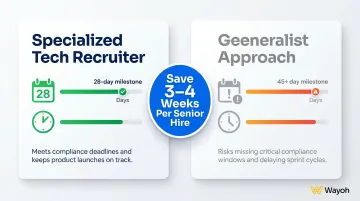
For companies scaling to meet regulatory requirements or product milestones, a 3-4 week reduction in time-to-hire directly affects delivery timelines and team capacity.
Dual-Dimension Screening
Internal recruiting teams often excel at culture and soft-skills screening but lack the depth to evaluate a candidate's HIPAA implementation experience or their understanding of PCI DSS scoping. Specialized tech recruiters assess both dimensions before a single internal interview hour is spent — evaluating compliance literacy alongside technical capability.
Wayoh, which has built its practice over 10+ years with 500+ placements across Banking, FinTech, and HealthTech, exemplifies this model in practice. The firm engages passive candidates through direct conversations and personal market knowledge rather than automated matching. That hands-on approach produces faster shortlists and fewer wasted interviews for hiring teams.
A Structured Process Reduces Internal Friction
A strong recruiting partner provides more than candidate names. Throughout a search, hiring managers should expect:
- Clear evaluation criteria aligned to the role's compliance posture
- Regular pipeline updates and honest candidate assessments
- Compensation guidance and counter-offer preparation
- Coordination across scheduling, offer management, and onboarding support
This structure reduces leadership uncertainty and keeps searches moving — which matters most when a delayed hire means a stalled product release or a missed regulatory deadline.
Interim vs. Permanent Engineers: Choosing the Right Hiring Model
Not every engineering need requires a permanent hire. The distinction matters more in regulated industries than most.
When Each Model Makes Sense
| Scenario | Recommended Model |
|---|---|
| Core product engineering with long-term system ownership | Permanent |
| Deep institutional knowledge requirements | Permanent |
| PCI DSS audit sprint or compliance remediation project | Interim/Contract |
| Leadership gap while permanent search is underway | Interim |
| Major infrastructure migration or platform re-architecture | Contract |
| Urgent coverage during a product launch | Contract |
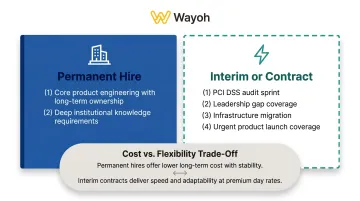
Permanent hires make sense when system ownership, institutional knowledge, and ongoing product contribution are the priority. These are the engineers who become the internal experts that future hires learn from.
Interim engineers are typically senior-level professionals brought in to lead or stabilize a function for a defined period. An Interim CTO covering a leadership transition, or an Interim Head of Platform Engineering during a major migration, delivers immediate impact without a lengthy ramp-up. For compliance-critical work with defined timelines, this model often outperforms a rushed permanent hire.
The Cost and Flexibility Trade-Off
Interim engineers typically carry higher day rates than permanent equivalents. But they require minimal ramp time, arrive with domain experience, and perform in environments where delayed compliance work carries regulatory consequences. For time-boxed projects, speed and expertise usually outweigh headcount cost.
That flexibility extends to the hiring structure itself. Firms like Wayoh build transparent conversion fee terms into interim engagements, so companies can transition a strong performer into a permanent role after evaluating fit in a live environment — without renegotiating from scratch.
What to Look for When Partnering with a Tech Recruiter for Fintech or Healthtech
Industry-Specific Credentials
Ask directly: has this recruiter placed engineers at payment companies, health data platforms, or digital banking infrastructure teams? A recruiter with active relationships in these spaces has a meaningfully different network than a general IT staffing firm.
The distinction matters because access to passive candidates (the engineers who won't respond to a cold LinkedIn message) depends entirely on the recruiter's existing relationships in the sector.
Evaluate Their Regulatory Screening Process
A quality tech recruiter for regulated industries should be able to explain how they assess compliance literacy during vetting. Ask specifically:
- Which compliance frameworks do you screen candidates for — HIPAA, PCI DSS, SOC 2?
- How do you distinguish between candidates who have implemented these controls versus those who have just worked adjacent to them?
- What questions do you ask to evaluate a candidate's HIPAA technical safeguard experience?
If the recruiter can't answer these questions clearly, they're not equipped to distinguish genuinely qualified candidates from those who sound qualified.
How Sector Roots Shape Candidate Vetting
Wayoh built its foundation in financial services compliance and risk hiring, partnering with community, commercial, and investment banks on AML, KYC, financial crime, and regulatory roles before expanding into fintech and healthtech. That history informs how they evaluate candidates — including why a HIPAA-compliant data architecture decision matters, not just whether a candidate can name the framework.
A firm built on general IT staffing approaches regulated hiring differently. Wayoh's positioning — helping organizations "hire the people who shape how health and wealth are delivered" — reflects sector investment accumulated over more than 3 years, not opportunistic expansion into a hot market.
Frequently Asked Questions
What is the difference between interim and temporary positions in recruitment?
Temporary positions are short-term and task-focused — typically days to a few months, covering QA support or workload gaps. Interim roles are senior-level and strategic, placing experienced leaders to manage transitions, fill leadership gaps, or drive complex projects for a defined period.
What makes fintech and healthtech engineering roles harder to fill than standard tech roles?
These roles require candidates to hold deep technical skills alongside working knowledge of regulatory frameworks — HIPAA, PCI DSS, SOC 2 — simultaneously. That combination significantly narrows the qualified candidate pool compared to general software engineering, where compliance depth isn't a baseline requirement.
Should I hire contract or full-time engineers when scaling a fintech or healthtech team?
Full-time hires work best for core product engineering, system ownership, and roles where institutional knowledge compounds over time. Contract engineers suit time-boxed compliance projects, platform migrations, audit sprints, or specialist work where ongoing headcount isn't needed after the project ends.
How long does it typically take to fill a senior engineering role in fintech or healthtech without a recruiter?
Senior technical roles in regulated industries routinely take 3-4 months or longer through standard channels, based on benchmarks from the SHRM 2025 Recruiting Benchmarking Report. Specialized recruiters with established networks can compress this timeline by several weeks.
How do I know if a tech recruiter truly specializes in my industry?
Ask them to name the compliance frameworks they screen for, describe specific placements they've made in fintech or healthtech, and explain how their candidate network was built in these sectors. Vague answers — or heavy reliance on job boards and databases — are red flags that reveal a generalist posture.
Can a specialized recruiter help with both permanent and temporary engineering hires?
Yes. Firms like Wayoh support both engagement models for fintech and healthtech clients. Engineering team needs shift frequently — permanent infrastructure engineers one quarter, interim security specialists the next — particularly around audits, product launches, or growth phases.